This book is an autobiography of Ayya Khema and can be purchased from Amazon. Below is a very short and brief introduction of her life along with the inspiring quotes. I would suggest everyone to look into Ayya Khema’s books which are both beneficial and enriching.
Ayya Khema shared her entire life journey. She was born a German in a Jewish family and was well protected when she was barely a young child. Misfortune happened and she had to leave her parents and was adopted by a couple. The couple adopted her because they needed a helper. With opportunities given to her, she moved away from them. She never settled down in a place for long. Ayya Khema traveled everywhere with her second husband and her son in a caravan. She traveled from country to country and finally she arrived in India and started her Dhamma journey. She meditated a lot with teachers she met along her way.
In 1979, Ayya Khema decided to be a nun and received a full ordination in California. She not only taught the Dhamma and meditation, she also donated to the building of halls for the nuns to practise and meditate. Ayya Khema went to Sri Lanka and in a small island, along with her friends, she established Parappuduwa Nuns island which is located in Ratgama Lake.
Unfortunately one day, terrible unrest broke out in Sri Lanka where bomb attacks and terrorist raids made life difficult that Ayya Khema no longer could continue staying at the Nuns Island and had to move again. She left for Germany in 1989.
Since 1983, Ayya Khema was diagnosed with breast cancer. She decided against an operation or to endless cycles of hospital treatment at that time. In 1993, finally she had to undergo a serious cancer operation as the lump had grown bigger and it was very painful for her and it broke and bled continuously.
In 1995, Ayya Khema found an ideal location not far away from Buddha Haus (a place where she created along with her good friends, and for like-minded people to learn the Dhamma and meditate) and built the first Buddhist forest monestery in Germany and it is called Metta Vihara (residence of unconditional love). It was opened in the summer in 1997.
Ayya Khema passed on 2 November 1997 at the age of 74. She had written many meaningful books on the Dhamma which is easy to understand and straightforward. Her meditation experiences provided a realistic way of understanding the process as well as the progress, all which is in accordance with the Buddha’s teachings.
Below are the quotes which I find it meaningful and down to earth!
The four efforts were simplified as follows, “avoiding, overcoming, developing and maintaining”. It was easy to memorise.
- Not permitting unwholesome thoughts to arise that have not yet arisen — in a word, avoiding
- Not engaging further in unwholesome thoughts that have already arisen — in a word, overcoming
- Arousing a wholesome thought that has not yet arisen — in a word, developing
- Engaging further in a wholesome thought that has already arisen — in a word, maintaining
“Pure love is love that has no wish to hold and to keep but is simply given freely.”
“I took walks in the jungle in order to look at nature as a part of myself. After all, in the end we are nothing different from nature.”
“Every person who practices with patience reaches a state of complete concentration. In this way, that person finds a way into the inner space of his or her mind, where absolute purity and clarity prevail. We are then all at once in a position to be able to look objectively at ourselves and the problems that so often threaten to overwhelm us. Through the experience of new levels of consciousness, a new field of vision opens that reveals the world to us anew.”
“The Buddha once said that the Dharma would take root in a country when sons and daughters of good families were ordained in their mother tongue. “Good family,” however, has nothing to do with wealth or fame. It refers to families in which children learn how to behave in virtue.”
“For the past twenty years I have had the feeling that I am not directing myself but am being directed — in the direction I have to go in so as to do what I’m supposed to do. And so I also think that I am in the right place at the right time and am bringing about here in Germany something for which there is a growing need.”
[After Ayya Khema had briefly explained the life of the Buddha. “Even in an abbreviated form, this story from the life of the Buddha shows what the Buddhist teaching is based on. We have to recognize dukkha, which is the Pali word for suffering, worry, lack of fulfillment, sickness, and death. By doing so, we see through the illusions that we have about our “ego” and our life.
We cannot achieve this (seeing the illusions of our “ego”) by means of our five senses and our usual way of thinking. For this, another level of consciousness is neccessary, which we can attain in the meditative absorptions — in concentration without thought.
In this way we see that we do not exist separately from the rest of creation. And seeing this, we can be freed from the unrelenting craving for recognition, love, respect, and confirmation. Then, at that point, it is no longer so important to us whether we are there or not. We then no longer have any fear of death.
For all this to happen, we only have to let go of something that is quite stubborn — our ego.
We live, we die like all those before us and all those after us, and nothing belongs to us. When we succeed in having no more desires, no more wishes, then death is not annihilation, but rather dissolution into nibbana (nirvana).
In order to make this attitude into something real within oneself, we must continue to practise.”]
“Even the magnificent chariot of a king decays; this body too is hastening toward decay. But the Law of the Noble Ones never decays. Noble ones proclaim it through noble messengers.” This means that we can say to the person that we all are going to die. The body is not the most important thing. The mind and consciousness of the good and true are much more important. They are not subject to decay.”
“I see myself as a person learning from all the human beings I meet and from the nature around me. I experience this with a feeling of happiness and of humility vis-à-vis this endlessly great creation.”
The End.
With this brief explanation and contemplation of what Ayya Khema’s had taught, may I dedicate this merit to my adopted cat, Monnie. May she have a calm and peaceful mind towards the end of her life and towards a favourable rebirth.



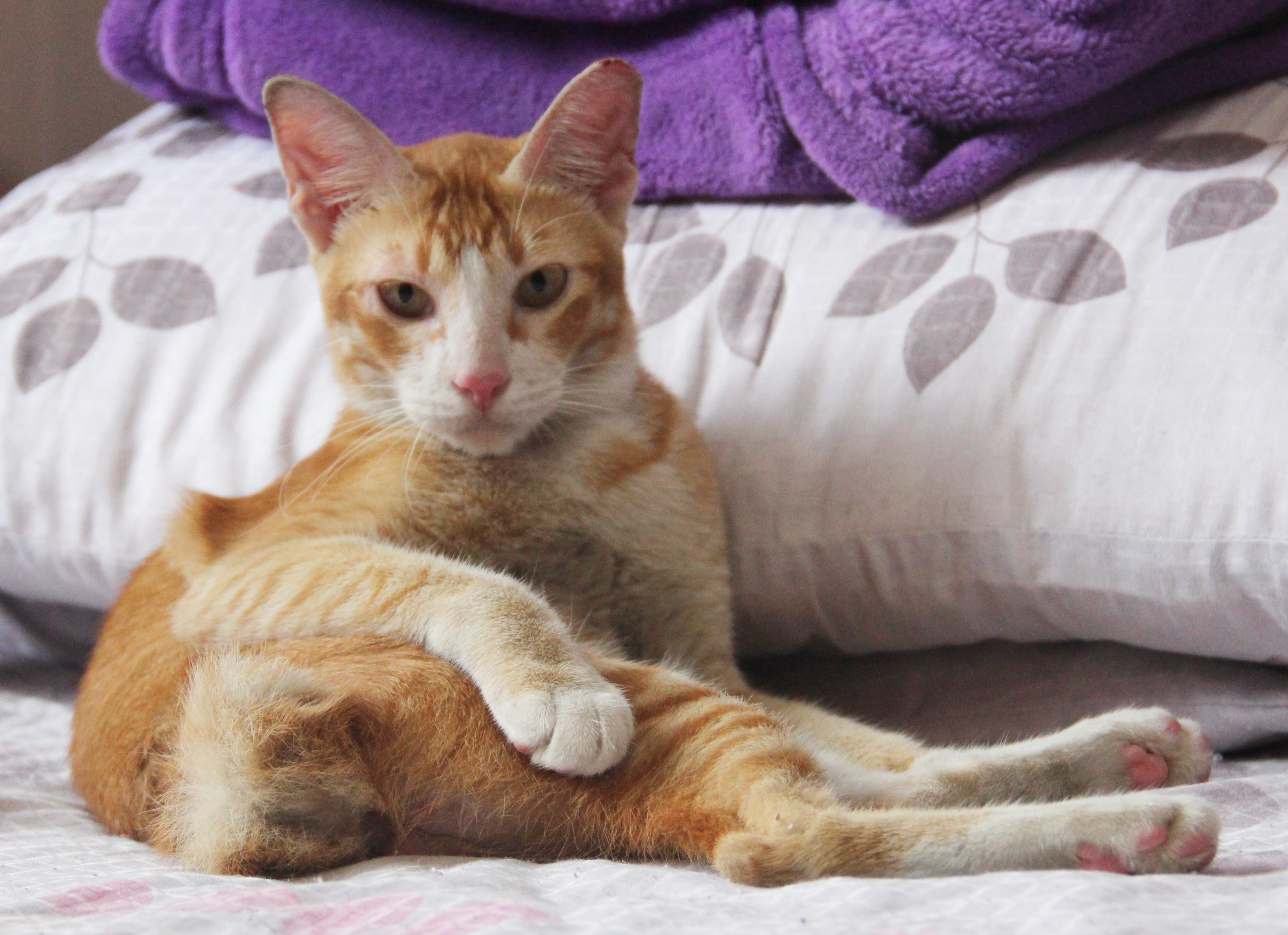


 Cats who teach me to fly...