Feeds:
Posts
Comments

Posts Tagged ‘Ayya Khema’

This was taught during a 10-day meditation retreat. The final chapter was a closing speech from Ayya Khama and it made me feel that I was attending the retreat and was bidding farewell. Yes, the Dhamma is not in the temple, it’s not anywhere but in our heart.

This book can be read by clicking the following link https://www.bps.lk/olib/bp/bp511s_Khema_Being-Nobody-Going-Nowhere.pdf

Below are a few quotes to ponder.

“One second of concentration in meditation is one second of purification because, luckily, the mind can only do one thing at a time.” 

“The spiritual path is all about letting go. There is nothing to achieve or gain.”

“The only time the mind can have a real rest is when it stops thinking and starts only experiencing.”

“A moment which brings the kind of happiness not available anywhere else, through anything else. A happiness which is independent of outer conditions. It’s not unconditioned but conditioned only by concentration. It’s not dependent upon good food or climate, entertainment or the right relationships, other people or pleasant responses or possessions, all of which are totally unreliable and cannot be depended upon because they are always changing…”

“Thinking is suffering, no matter what it is that we think. There is movement in it and because of that there is friction. Everything that moves creates friction. The moment we relax and rest the mind it gains few strength and also happiness because it knows it can go home at anytime. The happiness created at the time of meditation carries through to daily living because the mind knows that nothing has to be taken so seriously that it can’t go home again and find peace and quiet.”

“When the ego stops wanting, all unsatisfactoriness vanishes. This is why we should meditate. Now we’ll look at the ‘how’ of meditation.”

“When the mind becomes calm and tranquil, the breath becomes equally soft and tranquil. When the breath becomes so fine we can’t find it, that’s the moment when we actually enter into a concentrated state.”

“All minds are alike. You don’t have to think: I am especially unsuited for this. ‘Who’s ’I’ anyway? It’s just an untrained mind as opposed to a trained one. Anyone who enters a marathon race can run well and quickly if they have trained for it. It is silly to think I’m useless, I can’t run fast’ if you haven’t trained for it.”

“One doesn’t have to think about anything when meditating. Life keeps on happening and doesn’t need us to think about it. It’s constantly arising and ceasing every single moment.”

“The one way for the purification of beings, for the destruction of unsatisfactoriness, for entering the noble path, for realising freedom from all suffering, is mindfulness.”

“When people dispute what the Buddha was teaching, he didn’t argue. He wasn’t defending a viewpoint. He was talking about his own experience.”

“When that calm and pleasant feeling arises, which the Buddha called a pleasant abiding, and then it disappears again, which it must, because whatever has arisen will disappear, the first reaction that has to come to mind is knowing the impermanence; not, ‘Oh dear, it’s gone again.’ Or ‘That was nice. How am I going to get it back?’ Which is the usual way of reacting.”

“Liberation is not ‘knowing’, it is ‘feeling’. Everybody feels a ‘me’. Everybody knows their name but everybody also feels that the name describes this special ‘me’. One can feel the self. So in order to get to non-self, it has to be felt too.”

“The enjoyment of the sense becomes or refined when there’s more purification in a person. The smallest thing can be enjoyed, but the danger lies in wanting it. This wanting, the craving, brings the unsatisfactoriness because the wanting can never be fully satisfied. We’re always lagging behind. There’s always something more beautiful to be seek, something more to be heard or touched. There’s always something else. This creates much restlessness, because we can never get total satisfaction.” 

“The hope and anticipation of the gratification of sensual desire is that which makes it pleasurable. Once it has been gratified, it’s already finished and done with and new desire arises.”

“One antidote the Buddha prescribed for restlessness and distracted thoughts is learning more abut the Dhamma, the teaching. When one knows the teaching, one can direct the mind to it often. One remembers the Buddha’s words. When one learns more about it there are clear-cut and decisive answers in any kind of difficulty that arises. The Buddha’s answers always lead out of suffering. They always leads out of egoism, but they are not so easy.”

“The Buddha said the one who can get rid of these five hindrances is one who has finished the work, with nothing ore to be done.”

“I am the owner of my kamma. I inherit my kamma. I am born of my kamma. I am related to my kamma.. I live supported by my kamma. Whatever kamma I created whether good or evil, that I shall inherit. ‘The Buddha said we needed to remember this every day.”

“Right intention is our kamma-making process because our mental formations are having the intentions. Right view can be established in ourselves through some wisdom and insight. It will be foundation for our intentions. Intentions are constantly arising with every action and reaction. ‘Kamma, O’monks, I declare, is intention, are the Buddha’s words. This is how we make kamma, and if we believe that good kamma is essential for our wellbeing, we have to watch our intentions.”

“When we live with mindfulness there is a marked difference in our awareness. We know what’s happening with ourselves but we don’t become involved in it. When anger arises we know it’s arising, but we don’t have to become angry. That’s a great skill. When there is boredom, we know boredom has arisen, but we don’t have to become bored or frustrated. We just know the arising and also the ceasing of all mental states.”

Last but not least…

“There is no escape route externally or through non-attention or non-awareness. The only escape is through insight, which brings total clarity. Every other escape route is blocked.”

Read Full Post »

This book is an autobiography of Ayya Khema and can be purchased from Amazon. Below is a very short and brief introduction of her life along with the inspiring quotes. I would suggest everyone to look into Ayya Khema’s books which are both beneficial and enriching. 

Ayya Khema shared her entire life journey. She was born a German in a Jewish family and was well protected when she was barely a young child. Misfortune happened and she had to leave her parents and was adopted by a couple. The couple adopted her because they needed a helper. With opportunities given to her, she moved away from them. She never settled down in a place for long. Ayya Khema traveled everywhere with her second husband and her son in a caravan. She traveled from country to country and finally she arrived in India and started her Dhamma journey. She meditated a lot with teachers she met along her way. 

In 1979, Ayya Khema decided to be a nun and received a full ordination in California. She not only taught the Dhamma and meditation, she also donated to the building of halls for the nuns to practise and meditate. Ayya Khema went to Sri Lanka and in a small island, along with her friends, she established Parappuduwa Nuns island which is located in Ratgama Lake.

Unfortunately one day, terrible unrest broke out in Sri Lanka where bomb attacks and terrorist raids made life difficult that Ayya Khema no longer could continue staying at the Nuns Island and had to move again. She left for Germany in 1989. 

Since 1983, Ayya Khema was diagnosed with breast cancer. She decided against an operation or to endless cycles of hospital treatment at that time. In 1993, finally she had to undergo a serious cancer operation as the lump had grown bigger and it was very painful for her and it broke and bled continuously. 

In 1995, Ayya Khema found an ideal location not far away from Buddha Haus (a place where she created along with her good friends, and for like-minded people to learn the Dhamma and meditate) and built the first Buddhist forest monestery in Germany and it is called Metta Vihara (residence of unconditional love). It was opened in the summer in 1997. 

Ayya Khema passed on 2 November 1997 at the age of 74. She had written many meaningful books on the Dhamma which is easy to understand and straightforward. Her meditation experiences provided a realistic way of understanding the process as well as the progress, all which is in accordance with the Buddha’s teachings. 

Below are the quotes which I find it meaningful and down to earth!

The four efforts were simplified as follows, “avoiding, overcoming, developing and maintaining”. It was easy to memorise. 

  • Not permitting unwholesome thoughts to arise that have not yet arisen — in a word, avoiding
  • Not engaging further in unwholesome thoughts that have already arisen — in a word, overcoming
  • Arousing a wholesome thought that has not yet arisen — in a word, developing
  • Engaging further in a wholesome thought that has already arisen — in a word, maintaining

“Pure love is love that has no wish to hold and to keep but is simply given freely.”

“I took walks in the jungle in order to look at nature as a part of myself. After all, in the end we are nothing different from nature.”

“Every person who practices with patience reaches a state of complete concentration. In this way, that person finds a way into the inner space of his or her mind, where absolute purity and clarity prevail. We are then all at once in a position to be able to look objectively at ourselves and the problems that so often threaten to overwhelm us. Through the experience of new levels of consciousness, a new field of vision opens that reveals the world to us anew.”

“The Buddha once said that the Dharma would take root in a country when sons and daughters of good families were ordained in their mother tongue. “Good family,” however, has nothing to do with wealth or fame. It refers to families in which children learn how to behave in virtue.”

“For the past twenty years I have had the feeling that I am not directing myself but am being directed — in the direction I have to go in so as to do what I’m supposed to do. And so I also think that I am in the right place at the right time and am bringing about here in Germany something for which there is a growing need.”

[After Ayya Khema had briefly explained the life of the Buddha. “Even in an abbreviated form, this story from the life of the Buddha shows what the Buddhist teaching is based on. We have to recognize dukkha, which is the Pali word for suffering, worry, lack of fulfillment, sickness, and death. By doing so, we see through the illusions that we have about our “ego” and our life.

We cannot achieve this (seeing the illusions of our “ego”) by means of our five senses and our usual way of thinking. For this, another level of consciousness is neccessary, which we can attain in the meditative absorptions — in concentration without thought.

In this way we see that we do not exist separately from the rest of creation. And seeing this, we can be freed from the unrelenting craving for recognition, love, respect, and confirmation. Then, at that point, it is no longer so important to us whether we are there or not. We then no longer have any fear of death.

For all this to happen, we only have to let go of something that is quite stubborn — our ego.

We live, we die like all those before us and all those after us, and nothing belongs to us. When we succeed in having no more desires, no more wishes, then death is not annihilation, but rather dissolution into nibbana (nirvana).

In order to make this attitude into something real within oneself, we must continue to practise.”]

“Even the magnificent chariot of a king decays; this body too is hastening toward decay. But the Law of the Noble Ones never decays. Noble ones proclaim it through noble messengers.” This means that we can say to the person that we all are going to die. The body is not the most important thing. The mind and consciousness of the good and true are much more important. They are not subject to decay.”

“I see myself as a person learning from all the human beings I meet and from the nature around me. I experience this with a feeling of happiness and of humility vis-à-vis this endlessly great creation.”

The End.

With this brief explanation and contemplation of what Ayya Khema’s had taught, may I dedicate this merit to my adopted cat, Monnie. May she have a calm and peaceful mind towards the end of her life and towards a favourable rebirth.

Read Full Post »

The book can be purchased at Amazon. Ebook is available for loan at the Singapore National Library. 

In this book, Ayya Khema explained the way and how to meditate. She guided us along the path to insights through meditation. She elaborated on the Four Noble Truths, Twelve links of Independent Origination and the transcendental dependent arising. The importance of faith and confidence in the Buddha, Dhamma and the Sangha. She explained the Four Establishments of Mindfulness, the Jhanas on both material and non-material meditative absorptions and the Seven Factors of Enlightenment.

Below are the brief explanation and quotes:

Meditation is the only way to arrive at deep concentration and it is a means and a tool and not an end in itself. The goal of meditation is insight, and tranquility (samatha) is the means to that end. Thinking is our habit and we need to stop thinking in order to have control. To control requires meditation.

Quote: Unsatisfactoriness is a feature of existence. If we experience it in ourselves, we prove that the Buddha’s teaching is correct. That’s all. We don’t need to start suffering over it, we can just observe it and say, “Evidence.” There are innumerable things that expose us to unsatisfactoriness, but we can remember the first noble truth that “unsatisfactoriness is” and say, “That’s right, that’s what the Buddha taught.” End quote.

Our suffering is due to craving. The only way to deal with suffering is to let go of the wanting. To stop looking outward and to stop engaging in many unnecessary activities. Meditation helps us to keep looking inside ourselves.

Quote: The Buddha said, “The one way for the purification of beings, for the elimination of pain, grief, and lamentation, for the final ending of all pain and grief, for entering the noble path, for attaining liberation, is mindfulness.” 

“Meditation is the means by which we can practice mindfulness to the point where insight become so strong that we can see absolute reality behind the relative. Mindfulness trained in meditation can then continue in every activity.” End quote.

Many thoughts arise when we meditate. “If thoughts are like clouds in the background, not solid but quick to disappear, it is unnecessary to run after them with a label.

It is the same in our daily life. We drop unwholesome thoughts and substitute wholesome ones. just like we drop all thoughts in our meditation and bring our mind to our breath.

What we have experienced in the past has gone and the future is nothing but a concept. To gain insight and wisdom, we have to constantly live at the present. The more we live at the present, the more we experience the Four Noble Truths.

The Buddha spoke about four supreme emotions, which are the only ones worth having, they are loving-kindness (mettā), compassion (Karunā), sympathetic joy (muditā), and equanimity (upekkkhā). 

Quote: The Buddha said that in order to meditate properly one has to be comfortable in mind and body. We need a benevolent feeling toward ourselves, not only to give us ease in our daily lives, but also to succeed in our meditation. To relax within doesn’t mean that we no longer know what our defilements are but that we realise that why, too, are acceptable.” End quote.

Ayya Khema further taught three types of loving-kindness meditation and the five recollections which is important to me. 

  1. I am of the nature to decay. I have not gone beyond decay
  2. I am of the nature to be diseased. I have not gone beyond diseased. 
  3. I am of the nature to die. I have not gone beyond death.
  4. All that is mine, dear, and delightful will change and vanish.
  5. I am the owner of my kamma, the heir of my kamma, born of my kamma, related to my kamma. Whatever kamma I shall create, whether good or evil, that I shall inherit.

Quote: The Buddha said, “Who sees dependent arising, sees Dhamma. Who sees Dhamma, sees dependent arising.”

“We also need to remember again and again that meditation taken out of context cannot succeed. It may bring some peacefulness eventually, but it will not bring the real transformation that a spiritual path provides.” End quote.

To end the cycle of birth and death, whatever that is in our head and the things that we’ve experienced or come to us, we just have to be aware of it and not put ourselves into wanting the pleasant or getting rid of what is unpleasant. In other words, we practise equanimity, even-mindedness.

Quote: The whole of the Buddha’s teaching, and the sole purpose of meditation in the Buddha’s dispensation, is elevating our worldly, everyday, consciousness to liberation. End quote.

Feelings are just feelings. When feelings arise, we acknowledge and accept them without having to react. This way we can achieve equanimity.

Quote: We need to prepare the mind to become so calm, one-pointed, and strong that it will no longer flinch when it is confronted by the deepest truth. End quote.

We are made of four elements, earth, water, fire and air and it is impossible to find a “self” in this combination. The feeling and sensation that we have are impermanent. We focus on the arising and ceasing of feeling and sensation in the meditation. When we have experienced the impermanence and the constant change, we’ll place ourselves as a little less solid than before. 

Quote: As long as our consciousness has not yet become Dhamma consciousness, we will all fall into that trap. End quote.

The Buddha often start with “secluded” when explained in the meditation process, it means “secluded from sense contact.” In order to be secluded from sense contact, we need to have the inner feeling of happiness, of ease, of contentment. Contentment and satisfaction come from knowing that one has done one’s utmost.

There are five spiritual faculties when developed bring fruition. They are mindfulness, faith, wisdom, energy and concentration. Mindfulness is the leader. We must always be mindful when we are sitting, walking, standing or lying down. Mindfully knowing what we are doing. Mindfully living at the present. Without mindfulness, we are constantly being carried away by our emotions and thus, suffering entails.

With faith, we are devoted and committed in our practice. Wisdom allows us to know whether we are devoted and committed to the truth. Unless we have that assurance, our faith could be ill placed.

Energy spurs us to meditate. With excess energy, we’ll experience mental and physical restlessness, thus our concentration will be affected. With less energy, we’ll fall into sloth and torpor. We’ll unable to concentrate. Balance is required to balance the faculties of both energy and concentration. 

Quote: When heart and mind are balanced, the mind understands what we are doing, and the heart can feel. The spiritual path can only be practiced through our feelings. If we understand the teaching but don’t feel any benefit, it is an intellectual exercise and belongs at the university. End quote. 

Practising tranquility is necessary for liberation and meditative absorptions are part of the path. Without meditation, we are not able to go deeper into understanding the Buddha’s profound teachings.

Quote: When we can stay with the subject of meditation and do not become distracted, we gain confidence through the experience that, first of all, it is possible to; secondly, that we are able to do it; and thirdly, that the results that accrue are exactly as the Buddha said. 

Initial and sustained application are the first two factors of the meditative absorptions and can be likened to unlocking the door to concentration.  End quote.

We have to meditate, study and practise the Buddha’s teachings and make it a habit. Gradually, it will become part of our life. As we sit and meditate and is able to enter into the meditative absorptions and with pleasant abiding, we’re able to purify our negative emotions like anger, ill will, hate or dislike. 

Ayya Khema further explained the way leading to the meditative absorptions which is the four jhanas and the four realms of non-material world. 

Quote: When we experience deep peace and contentment, with no wishes, no problems, the world can no longer hold the same attraction for us as it used to, and we have taken a step toward liberation. …”the knowledge and vision of things as they really are. Vision is the inner experience and knowledge is the understanding of it.” End quote.

Whatever that is happening in life is conditioned. Even our mental awareness is also conditioned. With sense contact, our sense consciousness generates feeling, perception and related thought follow. We observe pleasant and unpleasant feeling whenever it arises and ceases. This helps us recognise the causes of our feelings and enables us to better restrain in our thought, action and speech, not to be reactive. This way, we can divert our thought to a wholesome direction.

Quote: we investigate the five aggregates of which we are composed: body or movement, mind consisting of feeling, perception, mental formations or thoughts, and sense consciousness. When the process of arising and ceasing has become clear to us, it has given us such a significant insight into ourselves and others that we no longer need to get angry at anybody, because we know that our anger is merely one of the aggregates arising and ceasing. End quote.

Joy comes from gratitude and happiness and helps us in our meditation. The meditative steps that were taught by the Buddha leads to insight. The meditative absorptions are preconditions for the attainment of wisdom. When the mind is calm and collected, it is capable of “knowing things as they really are.” 

Quote: The attainment of liberation of freedom is a slow and arduous process, frequently even tedious, and sometimes appears to make no progress at all. At other times, profound insights follow each other so quickly that we would like to step back and say, “Not so fast, I’m not quite ready for all this!” End quote.

When we are disenchanted about the whole world around us, we no longer find them attractive nor would we want to cling to them. It is a gradual process into feeling dispassion. 

There are ten fetters that the Buddha spoke of. The first three are non-self, not being attached to rites and rituals and skeptical doubt. Non-self is losing the belief in ourselves as an entity, having identity or personality. One has understood that the body, feeling, mind and mental objects arise due to conditions. There is never a solid self. When one has understood the Dhamma, rites and rituals no longer seem important. However, that doesn’t mean that one cannot perform them. Understand that liberation requires the effort of practising and understanding the Dhamma and it has to be done by ourselves and nothing or anyone else can help liberate us.

Lastly, we have all the confidence in the Buddha’s teaching by studying, practising and meditating as well as insights into the Buddha’s teaching. Though not fully attained, is stable and not swayed by any external factors or other beliefs. 

Quote: Traditionally, it is said that a stream-enterer has a maximum of seven more lives as a human being before becoming fully enlightened.  However, it is possible for liberation to take place in a single lifetime. Such a person will remain the Buddha’s disciple and can never again break any of the five precepts. End quote.

The non-returner loses the fetter of hate and greed and see the world as it is. They no longer attracted to things around them and are aware that the conditions that have been keeping us in the cycle of birth and death. The remaining five fetters are restlessness, the desire to be born in the fine-material and the nonmaterial realms, conceit and ignorant. These fetters can only be eliminated when one has become enlightened. 

Quote: When aversion, rejection, resistance, anger, jealousy, pride, greed, or craving arise within, we can take a moment to look at them mindfully. When we recognise their burdensome impact on us, we understand that we need not continue to let them exist. We can substitute compassion, or the idea that they are not important, or the understanding of impermanence, or corelessnessEnd quote.

We all have the potential to become enlightened only when we practise in accordance with the Buddha’s teachings and perfect them!

The End.

With Ayya Khema’s “Know Where You’re Going”, I end the year 2024! 

Read Full Post »
The book, the Path to Peace, Ayya Khema explained the fifteen conditions on the Metta (loving-kindness) Sutta, which was taught by the Buddha, that will help us to lead to the path of peace. Below is The Metta Sutta.

The Metta Sutta

The Buddha’s Words on Loving-Kindness (Sutta Nipata 1.8)

Translated by Ven. Khantipalo

What should be done by one who is skilled in wholesomeness. To gain the state of peacefulness is this :

One must be able, upright, straight and not proud. Easy to speak to, mild and well content. Easily satisfied and not caught up in too much bustle. And frugal in one’s way, With senses calm, intelligent, not bold. Not being covetous when with other folk. Abstaining from the way that wise ones blame.

And this the thought that one should always hold: “May beings all live happily and safe and may their hearts rejoice within themselves. Whatever there may be with breath of life. Whether they be frail or very strong, without exception. Be they long or short or middle-size. Or be they big or small, or thick, or visible, or invisible. Or whether they dwell far or they dwell near, Those that are here, those seeking to exist, may beings all rejoice within themselves.”

Let no one bring about another’s ruin And not despise in any way of place. Let them not wish each other any ill. From provocation or from enmity. Just as a mother at the rise of life loves and protects her child, her only child.

So one should cultivate this boundless love to all that live in the world universe, extending from a consciousness sublime, upwards and downwards and across the world. Untroubled, free from hate and enmity. And while one stands, and while one walks and sits. Or one lies down still free from drowsiness. One should be intent on this mindfulness.

This is divine abiding here they say. But when one lives quite free from any view, is virtuous, with perfect inside won and greed for sensual desires expelled, one sure comes no more to any womb.

Below are the quotes from “The Path to Peace”:

1. One Should Be Able

“The first condition is that one should be able. This means something quite ordinary. One should have ability. One should have learnt something. Learning and studying was greatly prized by the Buddha and also by his disciples. And it is as well in our time.”

2. Upright

“The next condition is to be upright. “Upright”  is a word that we might not use very much. To be upright means to be truthful, to be reliable and responsible. To be truthful to others as a matter of course. But to be truthful to oneself of oneself – and that is much more difficult.”

3. Straight

“The next quality the Buddha mentions is to be straight. Now straight of course is similar to being upright, but it also means to be straightforward. The Buddha was very straightforward. When he thought it was stupid, he said it was stupid. He didn’t go around trying to hurt anyone, but he also didn’t try to hide behind nice words. He said flattery is also lying. It’s got to be straightforward truth.”

“To be straightforward necessitates  knowing oneself. If one doesn’t know, oneself, the straightforwardness can easily become an insult. That’s not what is meant. If one knows oneself, then one is able to speak straightforward from one’s own  experience. Then it’s not insulting but it can be illuminating.”

4. Not Proud

“Pride shows itself when we have a notion that we are something special, different, or something that we can put our finger on. We are in total flux, so that’s ill placed. But pride is something that people have as an underlying support system. And if we become aware of that, we can, of course, let go. But it is difficult to be aware of it.”

5. Easy to speak to

“Being easy to speak to is gaining that skill where we can let the ego subside long enough and be humble enough so that it will not create a disturbances. All disturbances that exist are created by the ego; there’s no other disturbance possible.”

6. Mild

“Mildness comes out first of all in one’s thoughts, and if one can have a grasp of the fact that there’s far more in the universe that meets the eye, literally speaking, one should start to be a little more humble about it. And aggressiveness will go.”

“We could say that being mild is equivalent to harmlessness, which is another way of saying that we don’t want to do anything to any creature that we wouldn’t like to have done to ourselves.”

“The more we assert ourselves, the less we’ll have peacefulness.”

“And if you don’t look after our self and aren’t mild towards ourselves, then it will be difficult to do this with others.”

“We maybe can do it intellectually, and the more our intellect is roaming around in our head. The better we think we can do it. Unfortunately that doesn’t work. It’s extremely unpleasant, because again and again we get a reaction from outside of us which shows us quite clearly that we didn’t do what we thought we were doing. It’s only when the heart speaks that we get the response that the heart of others can give.”

“Sensitivity means being more strongly aware. Being more strongly aware of one’s feelings and feelings around one. So for meditators it’s easier to become more sensitive.”

7. Well Content

“Contentment is one of the aspects which the Buddha mentions as needing to come before meditation.”

“So we need to be contented with everything that is ours – for example, our body, even if it’s sick. It’s alright, it doesn’t matter; all bodies get sick at one time or another; it’s only a matter of time. Sometimes they get well again, and sometimes they don’t. So we need to be contented with our surroundings, with the people that we are with, with our own abilities, with our whole way of having a place in this creation.”

“Sometimes having more brings with it wanting even more. And sometimes it brings utter discontent because of the fact that one can see that despite all the things that one has amass, none of them have kept their promise.”

“We are limiting ourselves, our potential is infinite – namely, to experience infinity and then knowing that within that infinity nothing and nobody is there.”

“So to be well content has to be now, and not after we have finished the next step on our proposed journey in this lifetime. Now. This moment has to be well content, because then we can go on to the next moment, and recognise that each moment is actually infinity, eternity, as long as we stay with the moment. When we have that as an understanding, some of our craving will reduce itself. It won’t disappear, but it will reduce itself.”

“But if we want to meditate, if we want to have peacefulness within in order to meditate and have loving kindness, to be contented is one of the necessary requirements with which to sit down. It means that there is a humble recognition that the whole of creation is exactly that in which we can find our footing. That we can connect to all of it and we need not be anything special.”

8. Easily Satisfied

“Contentment means to be right there, at this time, so we have to be easily satisfied.”

“It’s an absurdity, because the sense contact is momentary, and it has to be renewed constantly in order to bring any satisfaction. And if it’s renewed too often it doesn’t bring any satisfaction anymore.”

“So, the senses will never satisfied the mind.”

“If we can see that contentment depends entirely upon being easily satisfied with what is now, and not think of what we have to do tomorrow, next week, next year, 10 years from now…”

“The body can be painful, but the mind can still be peaceful. The sense contact may be totally neutral, no particular pleasure, but the mine can remain peaceful. It doesn’t have to be constantly alert itself to the sense contact.”

9. Not Caught Up in Too Much Bustle

“The more we try to prove that we are somebody, the less we have a chance to become nobody. And that’s what Nirvana is all about.”

“If our activities take us anywhere, we want them to take us out of dukkha.”

10. Frugal in One’s Way

“Frugality is considered to be a great virtue. No frugality is not synonymous with penny-pinching. Frugality means that one is respectful, respectful of the things that others have made or manufactured. It also means that we don’t fall into the error that our society has fallen into, a throwaway society.”

“Being careful with the things that have been made, watching over them, and repairing them, and using them to the last possible moment.”

11. With Senses Calmed

The mind which has a lot of sensual desire is an agitated mind.

To be contented, to be easily satisfied, to be frugal, these all go in the same direction- towards letting go.

“With senses calmed” is such an important point that the Buddha has it in innumerable suttas.

12. Intelligent

Intelligent is a mind that can make connections, they can connect one thing to another and thereby see the significance. If one can connect one’s own behaviour to the underlying tendencies of hate and greed, one knows what goes on. That’s intelligence.

13. Not Bold

And that is the equivalent to being mild.

The dependency on others, whomever that might be, is a complete bondage, which prevents growth on the spiritual path.

14. Not Being Covetous When with Other Folk

The next condition is not being covetous when with other folk. That’s one way of translation. Another way of translation that is “not being swayed by emotions of the crowd”.

Joy with others is the third one of the four brahma-vihāras, the divine abidings, the paradise within, the highest emotions. It is a skill that needs to be practised. It needs intelligence. Practically all of this needs intelligence because it needs the insight to recognise how damaging envy is to oneself. 

When one understands that everything good that happens in the world is also part of oneself, then it’s much easier. But when one is still completely self-centred and self cherishing, and only concerned with one’s own well-being, then one can’t see that. But when we see that the world is togetherness of many different phenomena, then is easy to have joy with others.

15. And Abstain from the ways That Wise One’s Blame

To abstain from the way that the wise ones blame means that one does one’s best to actually follow the five precepts.

Conclusion: Ayya Khema used our galaxy as a comparison to our problems. When we compare our problems to the scale of the universe, they seem so minute. She also quoted “The Buddha said that one can’t stand still; it’s impossible”, and further  explained that there’s nothing that stands still in a person; one either grows or retards. We either grow in our understanding and purity, or we’re going backwards. So, maybe in the context of the size of this universe, we might see this as a personal goal.

*Ayya Khema’s ‘The Path to Peace’ can be purchased from Amazon and both ebook and hardcopy is available at the Singapore National Library.

Read Full Post »

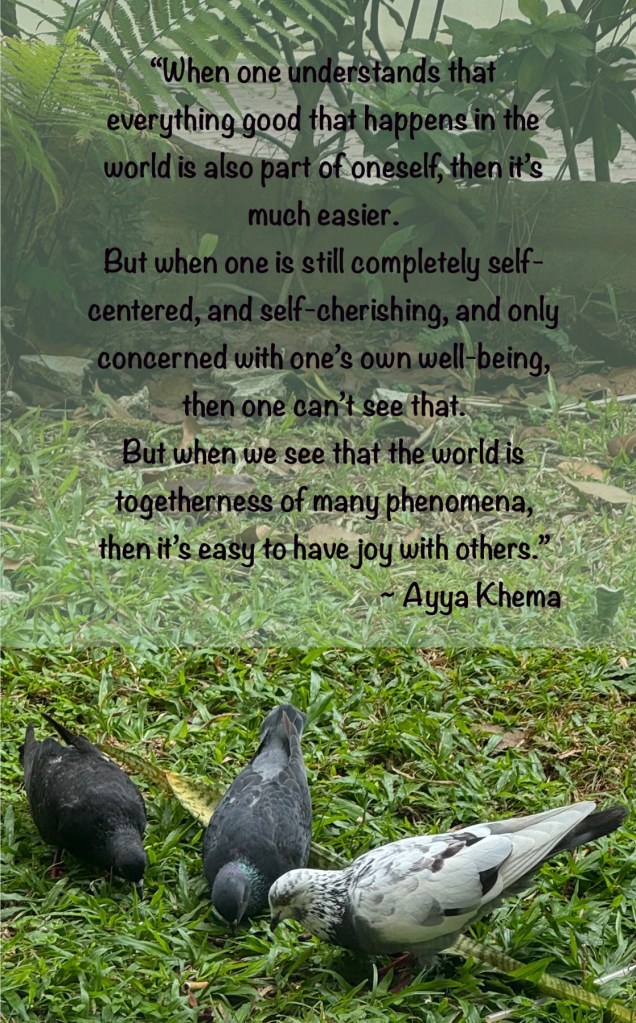
Quoted from the book “The Path to Peace”. Ayya Khema was trying to explain that we should rejoice in the good fortune of all living beings. Treating others with kindness is treating ourselves with kindness. We are all one.

Feeling joyful for the animals who have food to eat, colleagues who have promoted or those who have done good deeds is the purest form of joy. Consistently practise in this way brings us inner peace.

Be kind to all living beings. Smile when pigeons have food to eat:).

Please support using humane measures to control pigeon population. Below link is the petition to end pigeon culling.

https://chng.it/tWCDMhpPkf

Read Full Post »