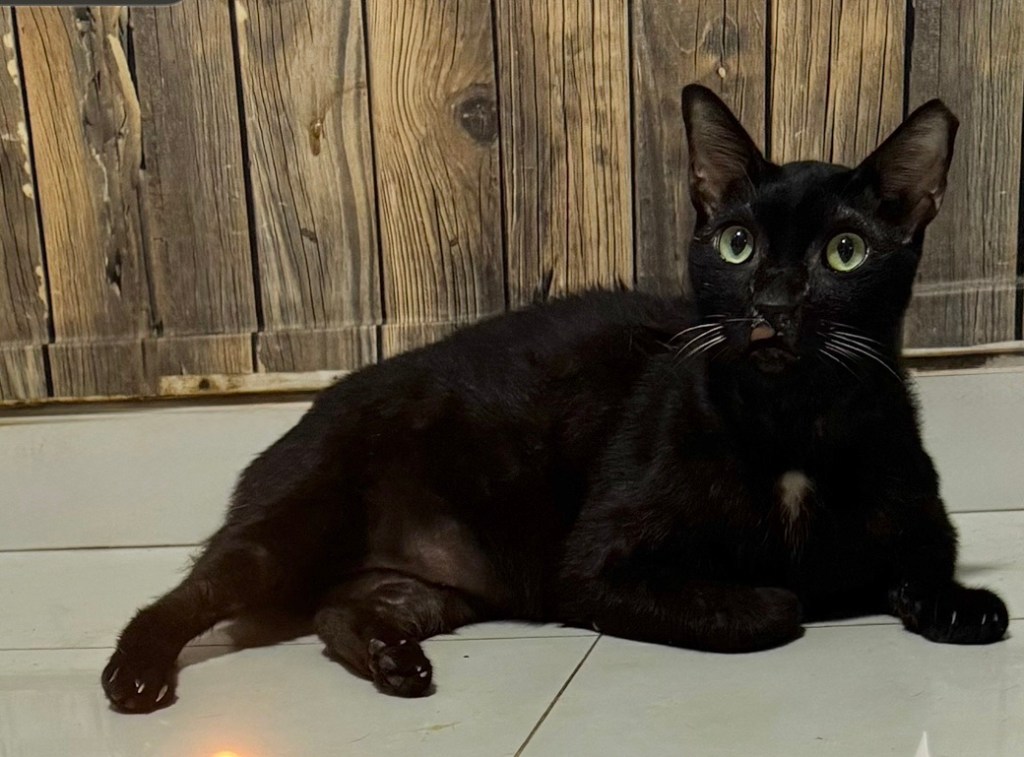
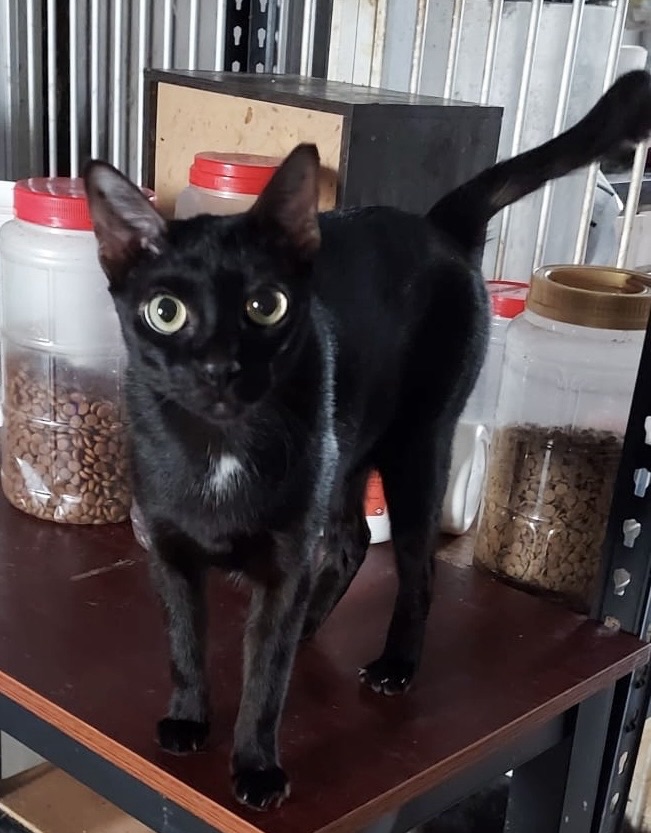
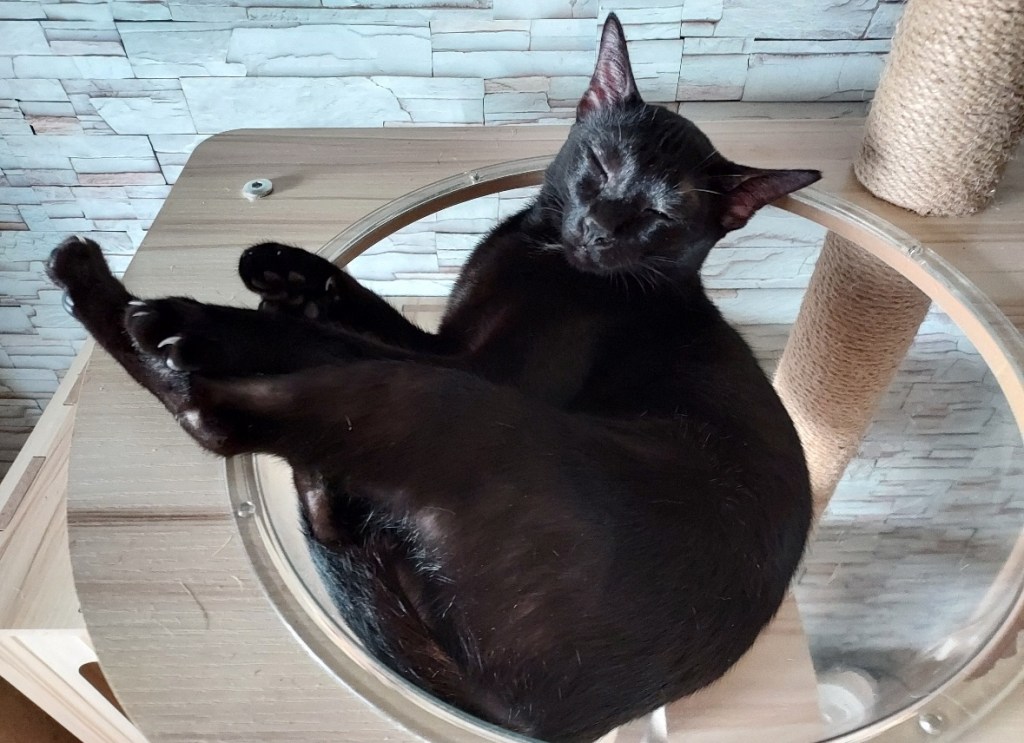
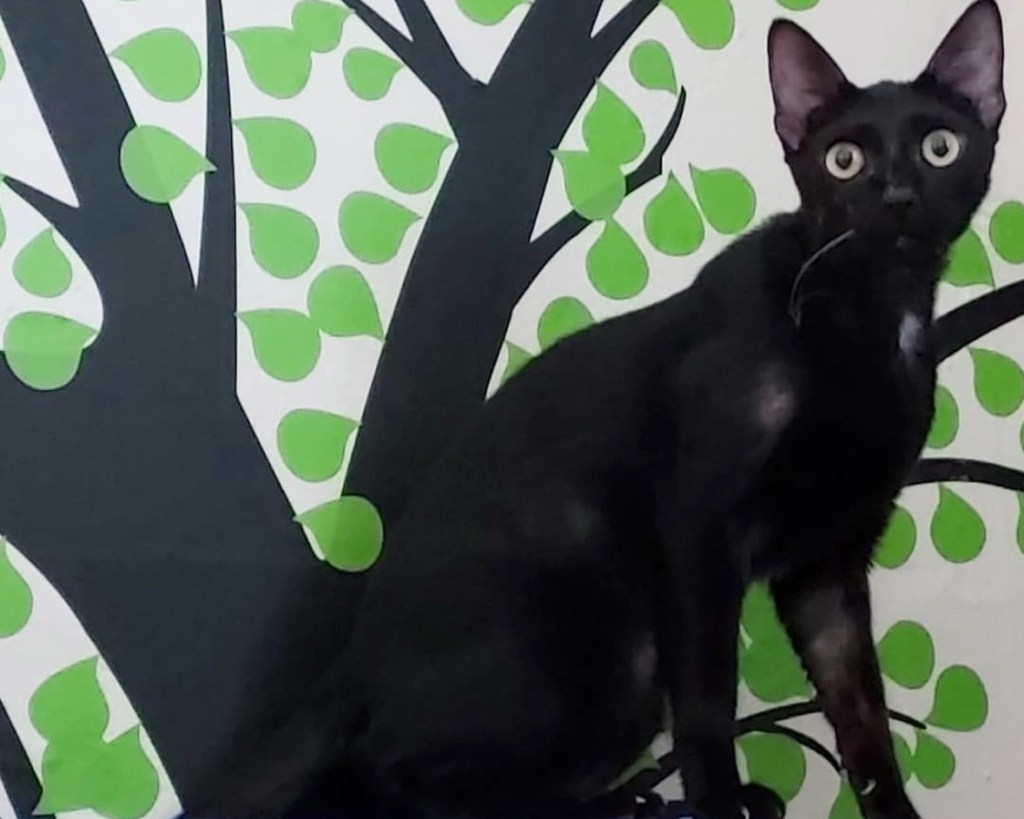
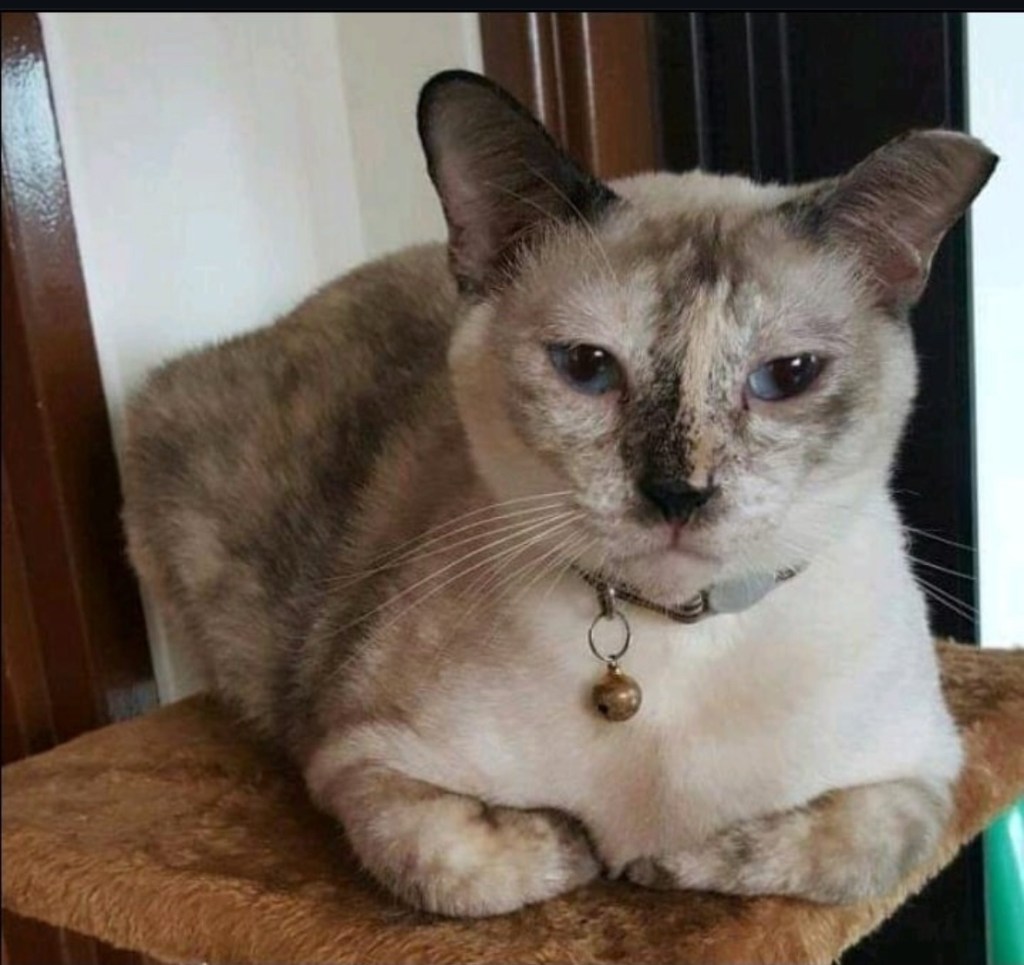
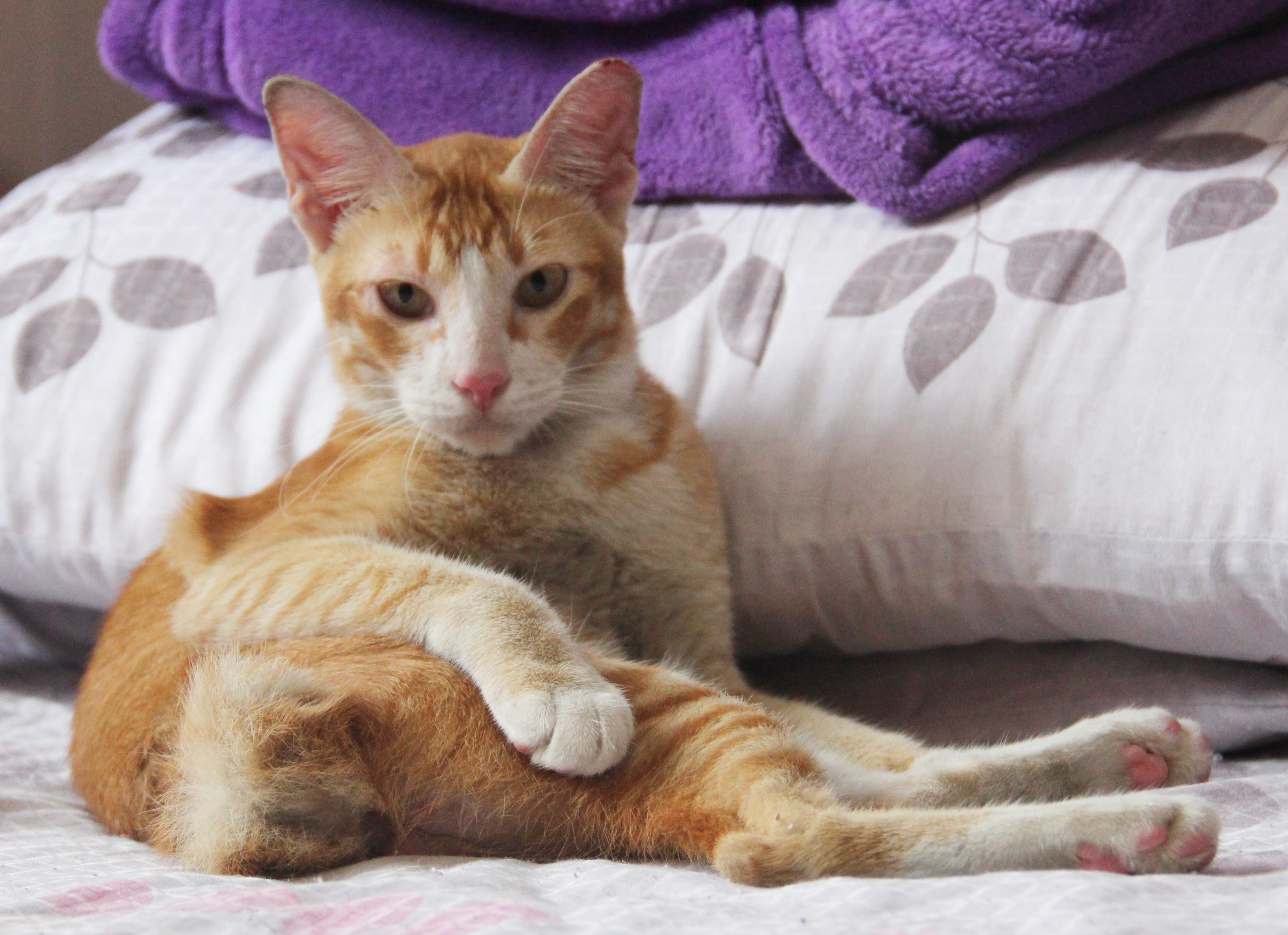
Nomu passed on peacefully. She lived till a ripe old age. We couldn’t do subcutaneous on her as her skin was thin and dry. It’s a sign of good old age and we are glad. She had a good life roaming freely and had food every night. When she was not looking good, she was brought home. She rested peacefully and had three meals a day and a small bowl of her favourite kibbles.
I opened the door cage for her but she was no longer interested in the outside world. Perhaps she thought all the home cats are babies because they never scratch real tree barks, step on real grass and watch the sunrise and sunset:).
We believe she was at least 12 years of age. The percentage of the community cats surviving more than 6 years old is low. Nomu was a fortunate one! Thanks to the feeders or the caregivers for they played a big role.
She had plenty of kisses and she really loved to be petted. I heard that she had plenty of treats before she fell sick. Little greedy Nomu:)!
Thank you Michelle, her caregiver, for providing her meals every day and many years.
May the merits accumulated be dedicated to her favourable rebirth.
The above photo was taken last night. I didn’t know 花包 was resting in her tiny shelter until I was about to leave after feeding them. I am glad that she is using it. I have tried to improve the shelter, hoping they could have more privacy. So I covered one side with a cardboard and made a small opening on the other side just in case someone comes to disturb them. There would be another exit to get out of the box.
I am thinking of making the two front windows smaller and am still looking for a suitable carton box to place the cooling mat. The cooling mat has to fit well into the carton box so that they can sleep comfortably.
花包 sneaked quietly to the tiny shelter again just now. I hope she feels safe. There is a CCTV not far from where she is resting. Hopefully, it can deter and prevent people from doing anything harmful.
All feeders want their cats to be safe. With cases of cat abuse on the rise, feeders and rescuers have come together and make our voices heard. We demand justice, efficient investigations, transparency, and harsher punishment. Jail and fines are not enough, caning is the best punishment for those who inflict enormous pain to the cats. They must be made to remember what pain is. The pain that comes from caning. The same pain that they intentionally and brutally inflicted on the cats!
The cats that they killed are not only one but at least five. They slammed the cats against the wall multiple times and threw them from high floors. These cats were well taken care by their feeders. I can’t imagine the pain of knowing how they were killed. A few years back, there were two cats that I fed whom I suspected were abused. One was poisoned and another of internal injury. I asked our authorities to look into it but… they never listened to us!
All I wish for is their safety. I am ready to take all the cats that I am feeding when they are sick or old. Healthy cats are usually happier living on the streets. We need the community to help look after them and not just the feeders. Whenever there are other feeders helping out in my feeding area, I am always happy!
First thing first, thank you A.K. Warder for making the effort to go all the way back to the Buddha’s time and connect the dots.
Those who are interested to know when and how the Mahayana sutras and the abhidhamma emerged may consider reading this book.
A.K. Warder began by explaining the Buddha’s teachings that is the Four Noble Truths and the path. He gave us an idea on what the teachings were according to the early buddhist texts. One has to be familiar with the Buddha’s teachings in order to understand what Warder was saying, as he used different vocabulary and expressions in describing and interpreting the text which is different from Bhikkhu Bodhi (you may have read the Nikāyas translated by him). I am a fan of Bhikkhu Bodhi and am so used to his way of expression and interpretation. I’ve heard some monks criticise him. However, to me, he is the best! Without him, I wouldn’t have understood the Dhamma. Bhikkhu Bodhi has benefited countless people. I may not understand the Pali Canon, but in my experience, “volitional formation” is still the best interpretation!
Warder explained how the Dhamma was interpolated by the monks from different schools of thoughts and how power played a role in shaping Buddhism. I am often curious about how monks started with poetry and story-telling and it was due to the popularity and trends during that time, as people wanted to make Buddhism more attractive. Some monks had been poets or actors before they gone forth. Warder also described how the first schism came about.
Finally, I have come to the topic of Nagarjuna. I remember reading his book “The Precious Garland” but I don’t remember what this book was all about. Probably because the Buddha’s teaching(Nikayas) had overshadowed his theories. In this book, Warder recalled what I had studied. Despite all the theories and ideas that Nagarjuna had presented based on his understanding, it only told me that he had not experienced the Buddha’s teachings. The Buddha’s teachings is profound but not complicated. They are straight forward only if we all make an effort, be heedful and listen to the Buddha and meditate.
Many new Mahayana sutras were created and added later. In order to claim that their sutras were the true teachings of the Buddha, some texts were derived from the early texts. The Pure Land school was also a later development. Shakyamuni Buddha spent six years of his life, going through so much sufferings in search of truth and liberation… only for it to be corrupted by all these monks who thought they were better than the Buddha! These monks have brought suffering to those who really wanted to know and practise the true teachings.
I couldn’t explain everything that Warder discovered. I didn’t and couldn’t memorise all the schools, places and the monks involved except the well-known ones. It’s a heavy book for me but I would still encourage anyone to read it if you would like to know more:).
What I am trying to say is, we don’t need Abhidhamma to understand the suttas. The suttas alone are sufficient for us to be on the path. Those who have understood the suttas would probably not waste time on Abhidhamma. Let’s not confuse our mind and complicate the Buddha’s teachings. The Buddha’s teaching on the Twelve Links of Dependent Origination is important. Do not cling to existence. Do not crave a land to be. Reaching out to the external (name and form) is activating our six sense bases and our conscious mind. All these would only lead us to endless sufferings, not towards liberation. This was not encouraged by the Buddha! Do not be misled!
Unless the Buddha himself taught the Bodhisattva path, teachings from unawakened beings may delay our learning and practice of the true Dhamma. Worse still, we may even end up in the three woeful realms because of teachings not taught by the Buddha but by ordinary monks.
Below is one of the poems believed to be composed during the Buddha’s time and I am very impressed.
First verse of an autobiographical peom:
Intoxicated with poetry we wandered from village to village, from city to city, then I saw the Buddha’s ho had gone beyond all principles.
Short poem on the Buddha:
More than a thousand monks attend on the Well-gone as he teaches the clear doctrine, nirvāna which knows no fear from any source,
They listen to the abundant doctrine taught by the Perfectly Enlightened One,
-how glorious the Buddha is, facing the community of monks!
O Master, your name is ‘Dragon’, best sages, for like a great cloud you rain on your pupils.
Leaving the afternoon rest from a wish to see the teacher,
O great hero, your pupil Vāgīśa salutes your feet.
On Sāriputra:
Profound and wise, learned in the Way and the wrong way,
Sāriputra of great understanding teaches the monk the doctrine;
He teaches briefly, also speaks in detail, pours out his improvisation like the song of the mynah bird;
By his beautiful voice, soft and exciting, the thoughts of the monks are elated and gladdened as they listen intently.
It was already past midnight but i am determined to get it done. I know 花包 loves carton boxes. I promised her three days ago that I would get a carton box for her. I forgot about it until last night.
I bought a washing machine more than a week ago. I kept the box for seven days just in case if the washing machine didn’t function properly, I can do a one to one exchange.
The carton box has to be flat when I brought it to the feeding area, otherwise it can’t go into my car. I spent half an hour cutting and tapping the box. Trying to make it sturdy. I used up the scotch tape and I am not done with all the tapping yet. I’ll have to get a new scotch tape tomorrow.
花包
She had been hiding and peeping at what I was doing. I knew she was somewhere at a different corner peeping because whenever I looked around, I saw half of her face looking at me.
I left a small carton box inside for her to sleep. The shelter looks big and I am thinking of adding a big carton box and a cooling mat for her.
After I left, I saw an unwanted carton box about 150m away. I took and folded it and walked all the way back. She was already sleeping in the shelter when I was there. I was glad that she likes it. Somehow the shelter looks a little empty.
The cooling mat and the carton box are ready! Instead of bringing it to her late at night, I am hoping to be there in the early afternoon. I told another feeder who was also feeding her and she will add a scratching post.
With the shelter, may 花包 and her good buddy, Curtain, have a safe and peaceful place to sleep!
Got a cup of bubble tea in the evening. The tea cup they gave me was different from others. I was delighted as the cup was tastefully designed.
So “i-tea” in chinese is call “爱茶”! It’s not “love-tea”, it’s “i-tea”! Not “我茶”, 是”爱茶”!:)
The printed scenery on the cup is nice. Very chinese! I don’t understand the chinese characters that was printed on the cup, but the 爱茶人 means tea lover. Why 一碗 and not 一杯?
This is the back of the cup.
The colours are nice. I think the cup is saying “admiring the mountain while drinking tea”. It uses the sky, smoke, spring water, fire, stone, clear water to describe the ambience. A native chinese would explain better. I am no where near. However, the red mark at the right bottom says “want it fresh, have i-tea”!
I am an art person, beautiful pictures often capture my eyes. Pleasure? Delighted! I am throwing it away. It’s just a paper cup!
“Bhikkhus, dwell with yourselves as an island, with yourselves as a refuge, with no other refuge; with the Dhamma as an island, with the Dhamma as a refuge, with no other refuge. ~ SN 22.43
“Enough, Vakkali! Why do you want to see this foul body? One who sees the Dhamma sees me; one who sees me sees the Dhamma. For in seeing the Dhamma,Vakkali, one sees me; and in seeing me, one sees the Dhamma.” ~ SN 22.87
A place to discover and explore the discourses of the Buddha.
I highly recommend reading the sutta translated by Piya Tan. His "Laymen Saints" has been an inspiration to many lay people.