Late yesterday morning, I was preparing to send my car for servicing. When I looked down from the level where I live, I saw policemen and a tent. From what I know, the tent is usually used to cover a corpse. At that moment, I couldn’t believe this was happening so close to me. I texted Mel and Xiumin to check, and they were sharp. Both said it was a suicide.
I took the lift down, and when the door opened, the police were examining the body. I saw that it was a middle-aged woman with long, curly hair. I was scared for a brief moment. Then a thought came to me, the body was just like that of dead birds, rats, cats, and dogs. Most importantly, we are the same. One day, I too will be that body. With that thought, the fear in me subsided.
I’ve lost hope with the monastic sangha and I no longer want to be involved. However, remembering Dhamma benefits me and with this, I am contented!
Late in the evening, I learned from the news that the woman who had fallen was 66 years old and the police believed there was no foul play. The investigation is still ongoing.
After feeding the cats past midnight, I happened to take the same lift as some residents here. As they were talking about today’s incident, I asked if they knew which level the woman lived, and they told me level 11. I was curious.
I told Mel that no matter how hard life gets, we should never give up. Where there is darkness, there is also light. Focus on the bright side. This also reminded me of Jane Goodall, who has always been a role model for me to live life to the fullest!
May the merits accumulated be dedicated to the deceased’s favourite rebirth!
Looking down from my level. The one with blue circle was the tent.
Day after day, no matter how I begged her feeders to bring her home, no one wanted to.
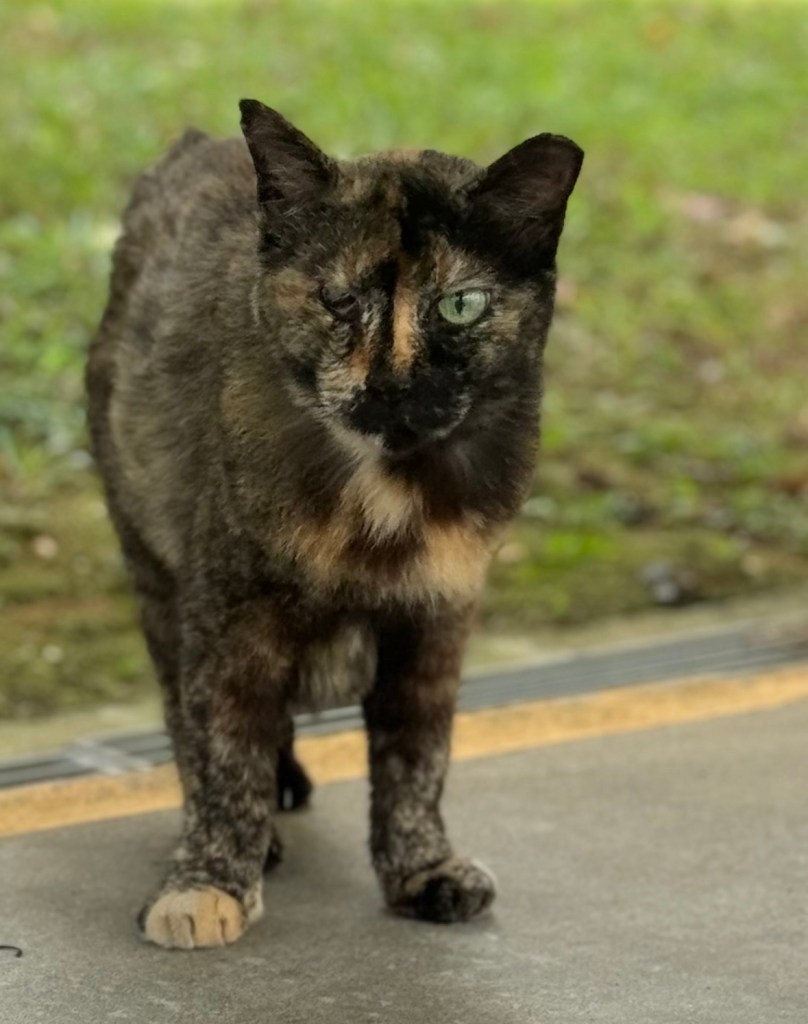
According to the residents, Huabao was at least 15 years old. She kept getting thinner and thinner, and this told me that her days were numbered. I tried so hard to persuade the feeders to let her retire at home.
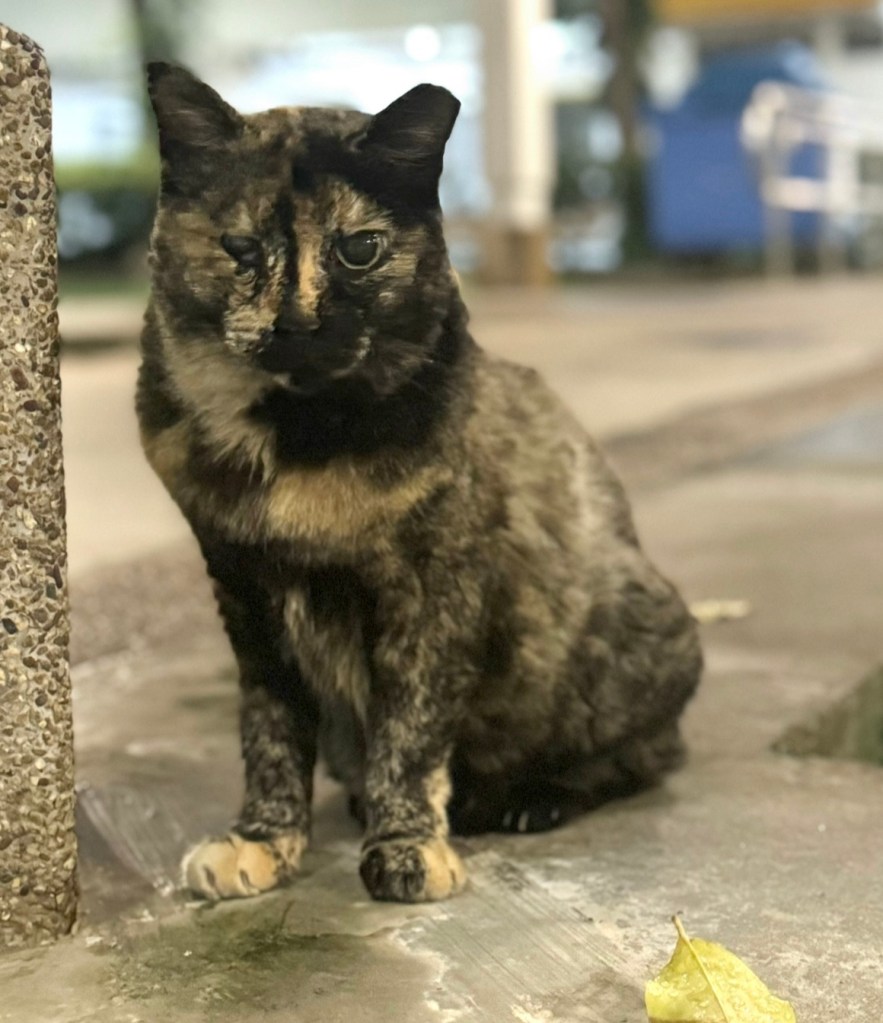
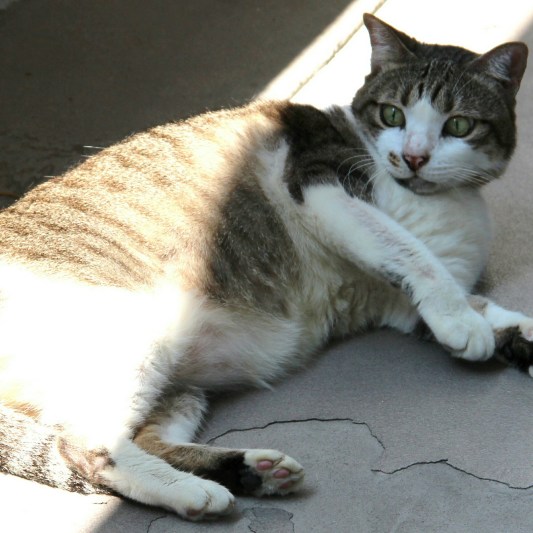
Every day after feeding the cats past midnight, I often saw Huabao sleeping at the roundabout where drivers would stop to pick up or drop off passengers. Huabao was not easily spotted because the lights were dim, and she was a tortoiseshell. I had to go to her and shoo her away to a safer place to sleep. Despite informing the feeders, no one wanted to take her in.
Based on Huabao’s condition, it was too dangerous for her to live on the streets. Quietly, I took her home without telling anyone. Nobody cared about her anyway.
The reason I took her home was to give her a roof over her head. She no longer had to wait for her meals or sleep on the cold, hard floor. She had clean filtered water to drink every day, free flow of kibbles, and three servings of wet food a day. Probiotics were often added to her gravy dish. I hoped she could pass on comfortably.
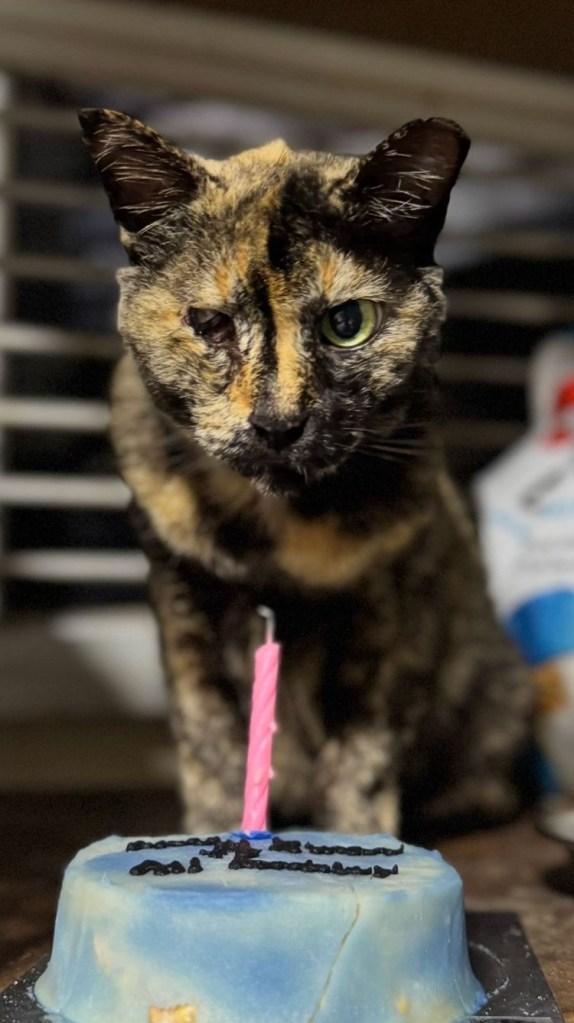
We had a Christmas celebration last year and she had a small portion of cake.
She was skinny when I took her home, and I was prepared for the fact that she could go at any time. She ate and slept well, and she would get angry when other cats came near her, which often made me laugh. Since the cats knew her habits, they avoided going near her. Sometimes, Huabao would relax in the center of the room. I placed a soft carpet for her to sleep on and set up a water fountain and food nearby so she didn’t have to walk far. She was old, and her legs were weak.
On the 1st of October, I saw her lying on the floor gasping for air. I took her to VES and she was diagnosed with heart disease. Her heart was three times larger than a normal heart.
Her lungs were filled with fluid, and the vet could hardly feel any pulse in her hind legs. Her blood pressure was low. Even when she was stabilized, her breathing was deep and labored. She rested in an oxygen chamber. Her prognosis was poor.
We were forced to make a decision, either to put her to sleep or bring her home. I knew that if I brought her home, she would be gasping for air again. I discussed it with Mel, and she took a half-day leave to visit her. We hated having to make such a decision, but if we didn’t, Huabao would have continued to suffer. If the residents were right about her age, she should have been 16 years old by now. I really didn’t want to see her struggling for breath.
We sent her for cremation the next day.
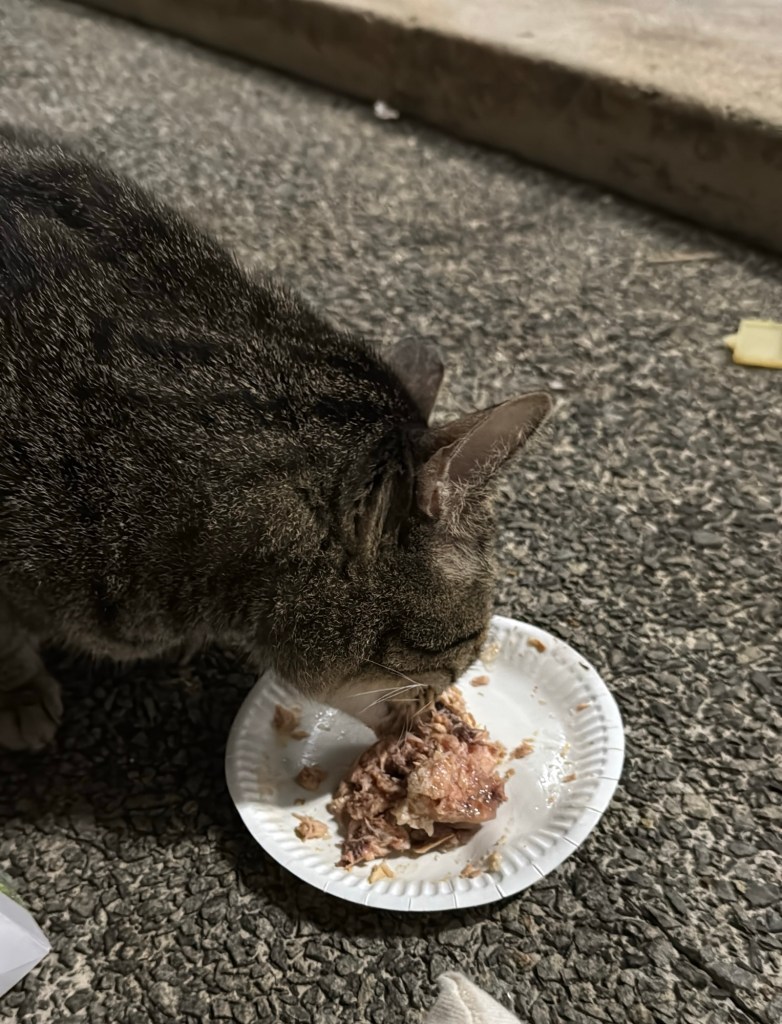
Someone made offerings to their ancestors, one day and Huabao took advantage of it. I liked watching the way she ate.
At first, I didn’t want anyone to know, but today I learned about another sick and old cat, also cared for by the same feeders, who refused to give him a home. They preferred the cat to keep roaming. This reassured me that I had done the right thing by bringing Huabao home. No one cared for her anyway.
This group of feeders has no experience in caring for cats. They didn’t know that a cat with kidney disease requires subcutaneous fluids. They didn’t know that chronic kidney disease can cause vomiting and even a low red blood count. Worse still, they didn’t even know that an aged cat may have lost its reflexes, have poor eyesight, and weak bones. They can’t defend themselves!”
If they don’t see me as a good rescuer, I hope they can find someone who is experienced and patient, someone who will not give up easily. I hope the cat will not have to hide in the drain and die.
I am glad that Huabao didn’t have to go through that. I am proud to have been her caregiver!
Thank you, Melanie, for supporting Huabao in every way!
May the merits accumulated be dedicated to Huabao’s favourable rebirth.
“You may not be able to solve global problems but there’s a lot you can do to make this a more peaceful world, starting in your own community.
Think about your own environmental footprint, even small actions like saving water, moving towards a plant-based diet, helping in soup kitchens or animal shelters, raising money for a charity of your choice or simply treating the people you meet with respect, treating animals with kindness. These are the kind of projects that our Roots and Shoots members are working on.
And every year, they celebrate the United Nations International Day of Peace. And not only on this day, but throughout the year, working to foster respect and compassion and to make this better world.”
~Jane Goodall
I am already working on what I’ve highlighted above for many years. I used to think I was the only weird person who would like the world to become vegan. But Jane Goodall actually shared the same vision and I believe vegan activists also hope for a vegan world.
During one of the interviews, Jane Goodall spoke humorously that she wish to send Elon Musk, Donald Trump, Vladimir Putin, Xi Jinping and Benjamin Netanyahu to Mars on a (Elon)Musk’s spaceship and that Trump would be the host!
I hope we can all strive to live in a way that minimises harm to animals, protects our environment and safeguards the climate for future generations.
Someone told me that I need not feed the cats in one of my feeding areas as there are feeders feeding them. As a result, I stopped feeding them for four days and on the fifth day, I decided to check on them and see if they were okay.
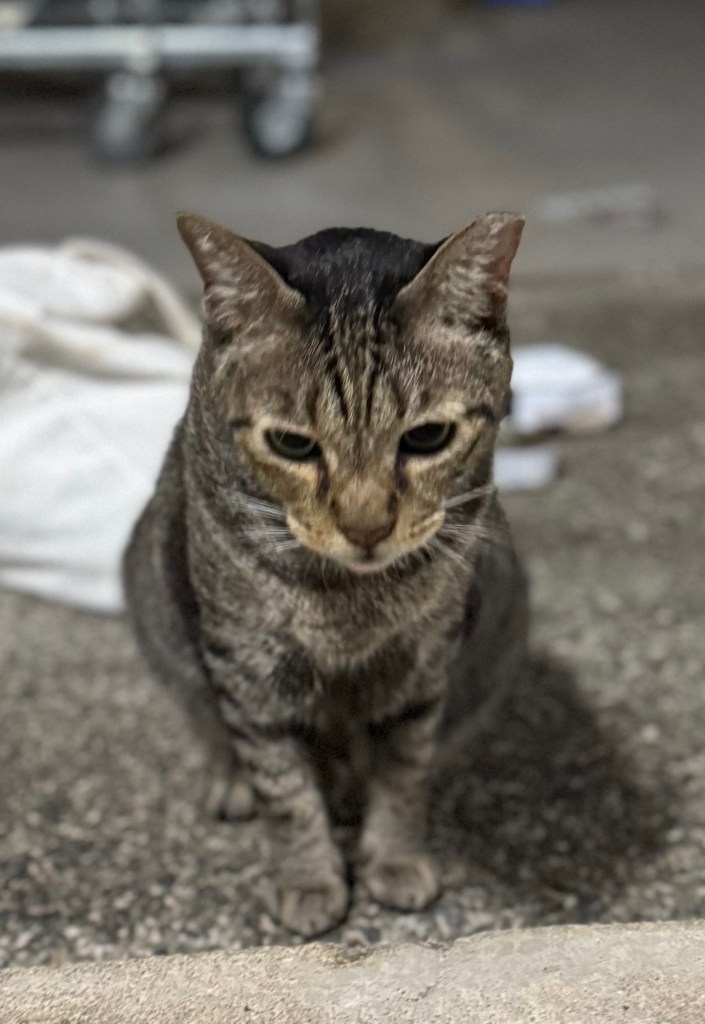
The grey tabby cat was waiting and looking at the direction I always come from. He leaped, made a sound and ran towards me. I was happy to see him again. I gave him his favourite kibbles and he ate it. I brought a new brand of kibbles, Soulmate, for them. He loved it. After eating the kibbles, he ate a whole can of wet food.
I went to check if there was clean water in their bowl. It was empty and I filled it up.
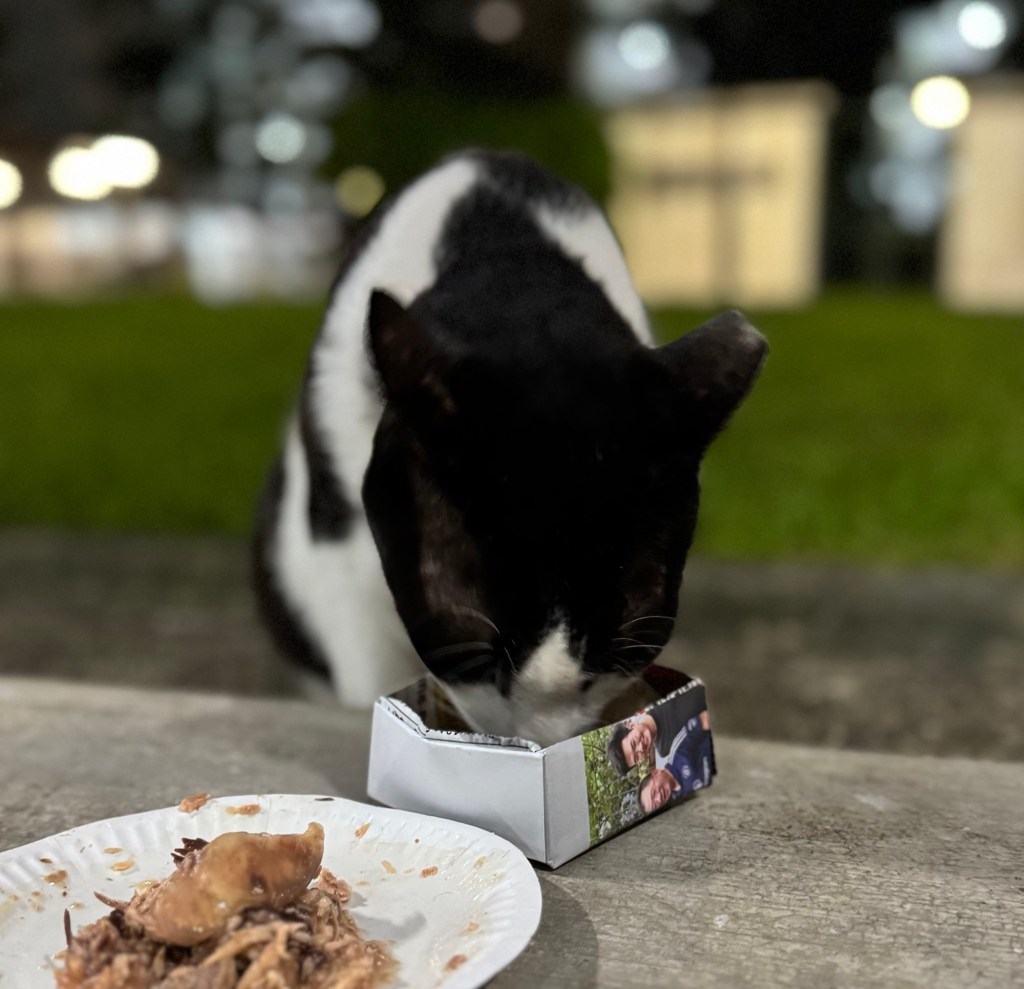
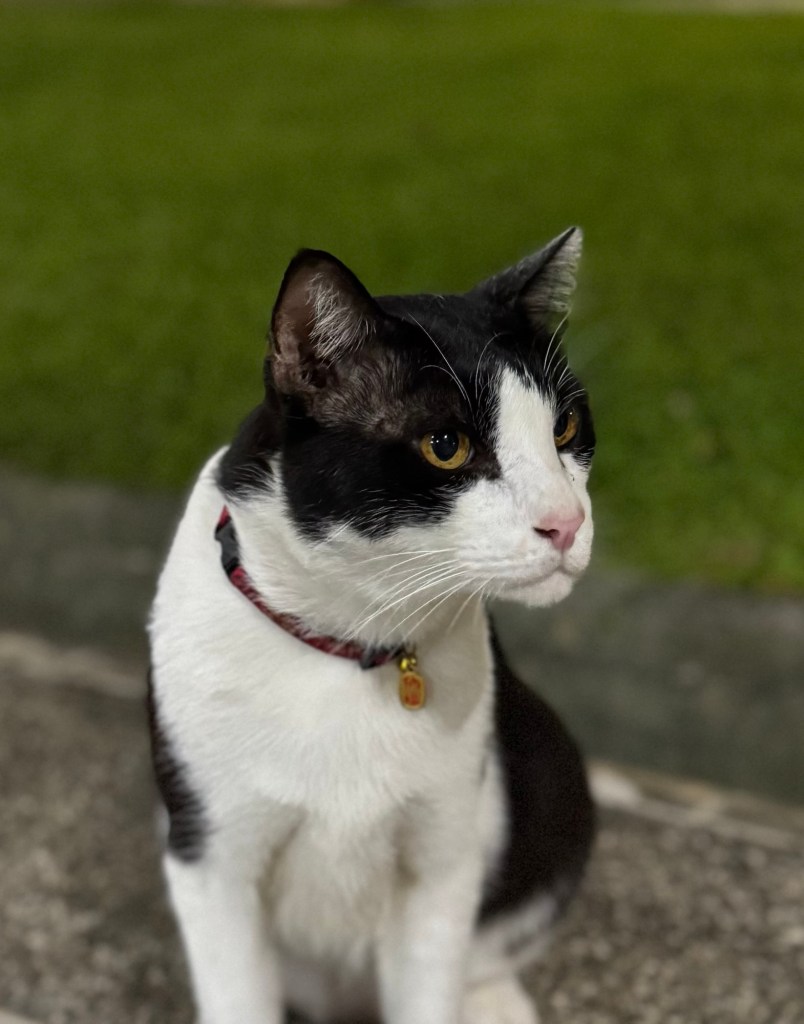
The black and white cat saw me and jumped down from the stacks of chairs where he had been sitting. As usual, he had to wait for his turn to eat as I didn’t want to waste too many paper plates. After the grey tabby cat finished the food, he would use the same plate and disposable bowl.
He, too, loves the new kibbles I brought for them and I kept refilling them to eat.
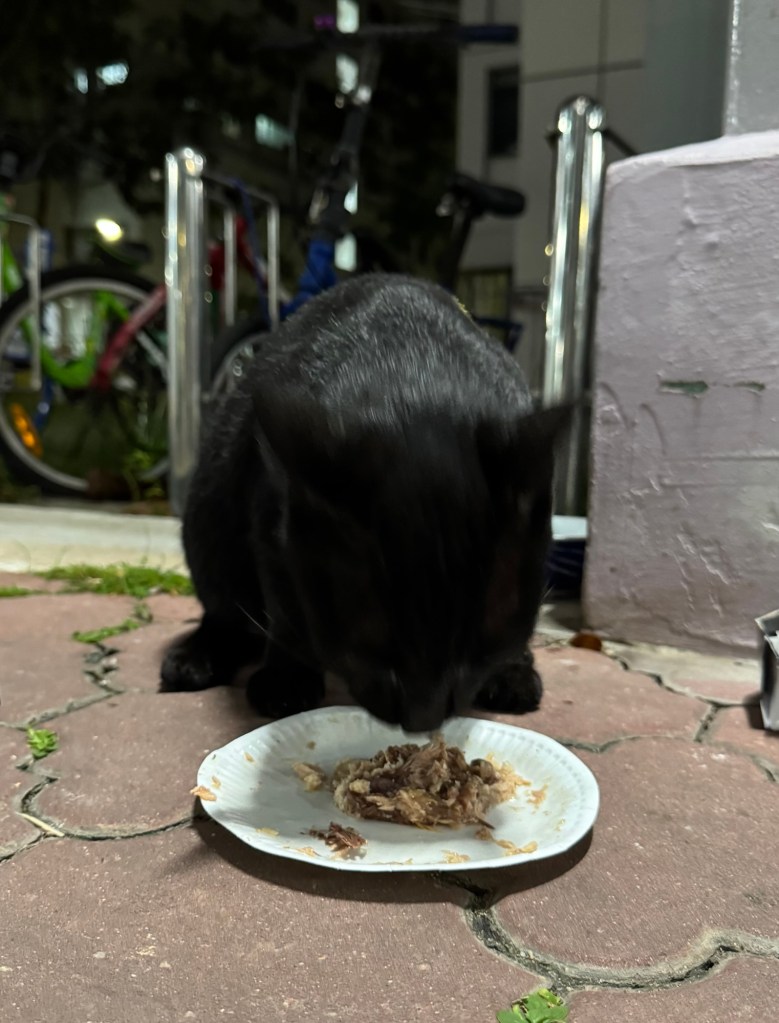
Next, I went to the black cat and he too dashed towards me asking for food. He only loves to eat wet food and hardly touches the kibbles. However, I would leave a small quantity of kibbles overnight, just in case they want to eat later,
He was so busy eating that he didn’t even lift his head.
I have actually been feeding them for a few years. Sometimes I wonder what I was thinking when I decided to listen to others and stop feeding them. For years, the cats have grown used to my presence and yet….
I believe they must have been waiting for me for the past four nights, until I finally came to check on them last night.
It’s nice to be with them again. I probably wouldn’t want to skip feeding them. When cats are full, they usually won’t eat. They are quite disciplined. I am looking forward to seeing them tonight!
My heart sank when I learned that Jane Goodall had passed on. It is a great loss for humanity. To me, she was the only hope for the world. No one could argue with Jane Goodall as she had a lifetime of experience working with chimpanzees. Not the scientists nor the scholars.
I am glad that I attended her talk and got to meet her last year. She was cool, humorous and brought hope to people and to the future.
When I think of her, compassion and peace fill my mind. To me, she was an icon of compassion. A real person whom I witnessed influencing others with her kindness and who deeply understood the suffering of animals. She recognised how we have destroyed the only place we live in and she dedicated herself to bringing hope to the people who also wanted to save the earth and help animals.
Many have worshipped figures they did not even know. Many have also worshipped those who spoke endlessly of loving-kindness and compassion, yet never acted on it. I could neither find nor feel compassion in those who preached so much about it. But in Jane Goodall, she truly possessed those qualities.
I am inspired by the way she approached life. Even at the age of 91, she remained active and tirelessly committed to doing what was right. Beyond being influenced by her compassion, her relentless energy showed me that as long as we are alive, we must keep truly living. She was real! There are no gimmicks or pretences.
Here are a few quotes from Jane Goodall that I would like to share:
“I think I’d like to be remembered as someone who really helped people to have a little humility and realised that we are part of the animal kingdom not separated from it.”
“Somehow we must keep hope alive, a hope that we can find a way to educate all, alleviate poverty, assuage anger, and live in harmony with the environment, with animals, and with each other.”
“The least I can do is speak out or those who cannot speak for themselves.”
“Thousands of people who say they ‘love’ animals sit down once or twice a day to enjoy the flesh of creatures who have been utterly deprived of everything that could make their lives worth living and who endured the awful suffering and the terror of the abattoirs.”
“We need to realise we’re part of the environment, that we need the natural world. We depend on it. We can’t go on destroying. We’ve got to somehow understand that we’re not separated from it, we are all intertwined. Harm nature, harm ourselves.”
“Only if we understand, can we care. Only if we care, we will help. Only if we help, we shall be saved.”
“We should have respect for animals because it makes better human beings of us all.”
Below is one of my favourite quote.
“What you do makes a difference, and you have to decide what kind of difference you want to make. Every individual matters. Every individual has a role to play. Every individual makes a difference.”
~ Jane Goodall (1934 ~ 2025)
Below is a video by the Jane Goodall Institute. It shows Jane Goodall and her team releasing one of the rescued chimpanzee. I was deeply touched by the chimpanzee”s reaction.
“Bhikkhus, dwell with yourselves as an island, with yourselves as a refuge, with no other refuge; with the Dhamma as an island, with the Dhamma as a refuge, with no other refuge. ~ SN 22.43
“Enough, Vakkali! Why do you want to see this foul body? One who sees the Dhamma sees me; one who sees me sees the Dhamma. For in seeing the Dhamma,Vakkali, one sees me; and in seeing me, one sees the Dhamma.” ~ SN 22.87
A place to discover and explore the discourses of the Buddha.
I highly recommend reading the sutta translated by Piya Tan. His "Laymen Saints" has been an inspiration to many lay people.







 Cats who teach me to fly...