Feeds:
Posts
Comments

The foremost of those nuns who analyse the meaning and widely discourse on divisions and parts [of the Dhama] is the nun called Dhammadinnā.

CLARIFICATIONS ON SELFING

[Visākha asked:] “Noble lady, [a reified sense of] identity has been expounded, the arising of [a reified sense of] identity has been expounded, and the cessation of [a reified sense of] identity has been expounded. What is [a reified sense of] identity, what is the arising of [a reified sense of] identity, and what is the cessation of [a reified sense of] identity?”

[Dhammadinnā replied:] “Honorable Visākha, the five aggregates of clinging are reckoned [a reified sense of] identity in the excellent teachings of the noble Dharma. What are the five? The bodily form aggregate of clinging, the feeling tone… perception… volitional formations… and the consciousness aggregate of clinging. The arising of [a reified sense of] identity is [due to] delight and attachment in relation to future becoming, together with craving that relishes here and there. The cessation of [a reified sense of] identity is accomplished through the removal of delight and attachment in relation to future becoming, together with [the removal of] craving that relishes here and there; through their complete renunciation, exhaustion, fading away, cessation, and pacification.”

[Visākha asked:] “Noble lady, how does the view of [a reified sense of] identity arise?”

[Dhammadinnā replied:] “Honorable Visākha, an immature ordinary person, who is not learned, regards bodily form as truly being the self, or bodily form as possessing the self, or bodily form as being in the self, or regards the self as truly abiding in bodily form. Likewise, they regard feeling tone … perception … volitional formations … consciousness as truly being the self, or consciousness as possessing the self, or consciousness as being in the self, or the self as abiding in consciousness. Thus, the view of [a reified sense of] identity arise.”

[Visākha asked:] “Noble lady, how does the view of [a reified sense of] identity not arise?”

[Dhammadinnā replied:] “Honorable Visākha, a noble disciple, who is learned, does not regards bodily form as truly the self, or bodily form as possessing the self, or bodily form as being in the self, or the self as abiding in bodily form. They do not regard feeling tone … perception … volitional formations … consciousness as truly the self, or the self, or the self as possessing consciousness, consciousness as being in the self, or the self as abiding in consciousness. Therefore, the view of [a reified sense of] identity does not arise. “

[Visākha asked:] “Noble lady, the aggregates and the aggregates of clinging have been expounded. Noble lady, how is it, are the aggregates the same as the aggregates of clinging, or else are the aggregates different from the aggregates of clinging?”

[Dhammadinnā replied:] “Honorable Visākha, the aggregates of clinging are the very aggregates, [yet] the aggregates are not [necessarily] aggregates of clinging. How is it that the aggregates of clinging are the very aggregates, [yet] the aggregates are not [necessarily] aggregates of clinging? Honorable Visākha, bodily form that is with influxes and clinging, feeling tone … perception … volitional formations … consciousness that is with influxes and clinging, there are aggregates as well as aggregates of clinging. Form that is without influxes and without clinging, feeling tone … perception … volitional formations … consciousness that is without influxes and without clinging, these are aggregates, but they are not reckoned aggregates of clinging.”

MORALITY, CONCENTRATION, AND WISDOM

[Visākha asked:] “Noble lady, regarding [the relationship between] the three aggregates (which are the aggregate of morality, the aggregate of concentration, and the aggregate of wisdom) and the noble eightfold path: how is it, noble lady, is the noble eightfold path encompassed by the three aggregates, or else are the three aggregates encompassed by the noble eightfold path?”

[Dhammadinnā replied:] “Honorable Visākha, the noble eightfold path is encompassed by the three aggregates; the three aggregates are not encompassed by the noble eightfold path. How is it that the noble eightfold path is encompassed by the three aggregates, [yet] the three aggregates are not encompassed by the noble eightfold path? Honorable Visākha, in this regard right speech, right action, and right livelihood have been assigned by the Blessed One to the aggregate of morality. Right mindfulness and right concentration have been assigned by the Blessed One to the aggregate of concentration. Right view, right intention, and right effort have been assigned by the Blessed One to the aggregate of wisdom. Honorable Visākha, therefore it should be understood that the noble eightfold path is encompassed by the three aggregates, whereas the three aggregates are not encompassed by the noble eightfold path.”

[Visākha asked:] “Noble lady, is the path conditioned or unconditioned?”

[Dhammadinnā replied:] “Honorable Visakha, it is conditioned.”

[Visākha asked:] “Noble lady, is cessation of the same nature?”

[Dhammadinnā replied:] “Honorable Visakha, it is not of the same nature.”

ON CONCENTRATION

[Visākha asked:] “Noble lady, how many factors does the first absorption possess?”

[Dhammadinnā replied:] ” Honorable Visākha, it possesses five factors: [directed] comprehension, [sustained] discernment, joy, happiness, and unification of the mind.”

[Visākha asked:] “Noble lady, regarding concentration, the cause of concentration, the power of concentration, and the development of concentration: Noble lady, what is the concentration, what is the cause of concentration, what is the power of concentration, and what is the development of concentration?”

[Dhammadinnā replied:] “Honorable Visākha, wholesome unification of the mind is concentration; the four establishments of mindfulness are the cause of concentration; the four right efforts are the power of concentration; the undertaking of these very qualities, their full undertaking, the abiding in them, practicing and applying [oneself] to them is the development of concentration.”

THE THREE FORMATIONS

[Visākha asked:] “Noble lady, regarding formations: noble lady, what are these formations?”

[Dhammadinnā replied:] “Honorable Visākha, there are bodily formations, verbal formations, and mental formations: these are the three.”

[Visākha asked:] “Noble lady, what are bodily formations, what are verbal formations, and what are mental formations?”

[Dhammadinnā replied:] “Honorable Visākha, exhalation and inhalation are reckoned as bodily formations; [directed] comprehension and [sustained] discernment are reckoned as verbal formations; perception and intention are reckoned as mental formations.”

[Visākha asked:] “Noble lady, why are exhalation and inhalation reckoned as bodily formations, why are [directed] comprehension and [sustained] discernment reckoned as verbal formations, why are perception and intention reckoned as mental formations?”

[Dhammadinnā replied:] “Honorable Visākha, exhalation and inhalation are bodily factors, they depend on the body, are related to the body, and depending on the body they enter its [domain]; therefore, exhalation and inhalation are reckoned as bodily formations. On having examined and discerned with [directed] comprehension and [sustained] discernment one speaks; therefore, [directed] comprehension and [sustained] discernment are reckoned as verbal formations. Perception and intention are factors arisen from the mind, go along with the mind, depend on the mind, are related to the mind, and depending on the mind they enter its [domain]; therefore, perception and intention are reckoned as mental formations.”

[Visākha asked:] “Noble lady, at the time when the body has been abandoned by these factors, when it is like a log, bereft of the mind, how many are the [other] factors that have been abandoned at that time?”

“Honorable Visākha, life [force], heat, and consciousness, these are the three. At the time when life [force], heat, and consciousness have been abandoned, the body is like a log, bereift of he mind.”

CESSATION ATTAINMENT

[Visākha asked:] “Noble lady, the occasion of passing away and dying and [the occasion] of entry into the meditative attainment of cessation: are these to be considered as distinct, are they different?”

[Dhammadinnā replied:] “Honorable Visākha, the occasion of passing away and dying and [the occasion] of entry into the meditative attainment of cessation: these are considered as distinct; they have a number of differences. Honorable Visākha, on the occasion of passing away and dying, the bodily formations have ceased, the verbal formations [have ceased], and the mental formations have ceased. Honorable Visākha, the life [faculty] and heat leave [the body], the faculties become otherwise, and consciousness departs from the body.

“On entering the meditative attainment of cessation, the bodily formations have ceased, the verbal formations [have ceased], and the mental formations have ceased. Yet, the life [faulty] and heat do not leave [the body], the faculties [do not] become otherwise, and consciousness does not depart from the body. Honorable Visakha, thus the occasion of passing away and dying and [the occasion] of entry into the meditative attainment of cessation are considered as distinct; they are different.”

[Visākha asked:] “Noble lady, how does the attainment of cessation take place?”

[Dhammadinnā replied:] “Honorable Visākha, a monastic who enters the attainment of cessation does not think ‘I enter the attainment of cessation.’ Their mind has previously been developed in such a way that, having been developed in that way, they will stay in it accordingly.”

[Visākha asked:] “Noble lady, how does the emergence from cessation take place?”

[Dhammadinnā replied:] “Honorable Visākha, a monastic who emerges from the attainment of cessation does not think ‘I emerge from the attainment of cessation.’ Yet, their mind has previously been developed in such a way that, having been developed in that way, they will emerge from it accordingly.”

[Visākha asked:] “Noble lady, when a monastic enters the attainment of cessation, which factors will cease first: the bodily formations, the verbal formations, or the mental formations?”

[Dhammadinnā replied:] “Honorable Visākha, when a monastic enters the attainment of cessation, the verbal formations will cease first, then the bodily and mental formations.”

[Visākha asked:] “Noble lady, when a monastic emerges from the attainment of cessation, which factors will arise first: the bodily formations, the verbal formations, or the mental formations?”

[Dhammadinnā replied:] ” Honorable Visākha, when a monastic emerges from the attainment of cessation, the mental formations will arise first, then the bodily and verbal formations.”

[Visăkha asked:] ” Noble lady, when a monastic emerges from the attainment of cessation, to where does their mind incline, to where does it flow, to where does it move?”

[Dhammadinnā replied:] “Honorable Visākha, when a monastic emerges from the attainment of cessation, the mind inclines toward seclusion, flows toward seclusion, moves toward seclusion; it inclines toward liberation, flows toward liberation, moves toward liberation; it inclines toward Nirvana, flows toward Nirvana, moves toward Nirvana.”

[Visākha asked:] “Noble lady, when a monastic comes out of the attainment of cessation, what contacts do they contact?”

[Dhammadinnā replied:] “Honorable Visākha, [they contact] imperturbability, nothingness, and signlessness.”

[Visākha asked:] “Noble lady, to enter the attainment of cessation, how many factors does a monastic develop?”

[Dhammadinnā replied:} “Honorable Visākha, this question should have been asked first. I will nevertheless reply to it now. To enter the attainment of cessation, a monastic develops two factors: tranquility and insight.”

FEELING TONES AND UNDERLYING TENDENCIES

[Visăkha asked:] “Noble lady, how many feeling tones are there?”

[Dhammadinnā replied:] “Honorable Visākha, there are three: pleasant, unpleasant, and neutral.”

[Visākha asked:] “Noble lady, what is pleasant feeling tone, what is unpleasant feeling tone, and what is neutral feeling tone?”

[Dhammadinnā replied:] “Honorable Visākha, [whatever] bodily and mental pleasure or happiness that arises from contact experienced as pleasant is reckoned as pleasant feeling tone. Whatever bodly and mental displeasure or pain arises from contact experienced as unpleasant is reckoned as unpleasant feeling tone. Whatever bodily and mental neutral or equanimous experience arises from neutral contact is reckoned as neutral feeling tone.”

[Visākha asked:] “Noble lady, what increases with pleasant feeling tones, what increases with unpleasant feeling tones, what increases with neutral feeling tones?”

[Dhammadinnā replied:] “Honorable Visākha, desire increases with pleasant feeling tones, aversion increases with unpleasant feeling tones, and ignorance increases with neutral feeling tones. “

[Visākha asked:] “Noble lady, do all pleasant feeling tones increase desire, do all unpleasant feeling tones increase averson, and do all neutral feeling tones increase ignorance?”

[Dhammadinnā replied:] “Honorable Visākha, not all pleasant feeling tones increase desire, not all unpleasant feeling tones increase aversion, and not all neutral feeling tones increase ignorance. There are pleasant feeling tones that do not increase desire but [instead] abandon it; there are unpleasant feeling tones that do not increase aversion but [instead] abandon it; and there are neutral feeling tones that do not increase ignorance but [instead] abandon it.”

[Visākha asked:] “Noble lady, what pleasant feeling tones do not increase desire but [instead] abandon it.”

[Dhammadinnă replied:] “Honorable Visākha, here a noble disciple, being free from sensual desire and free from bad and unwholesome states, with [directed] comprehension and [sustained] discernment, and with happiness and joy arisen from seclusion, dwells having attained the first absorption. With the stilling of [directed] comprehension and [sustained] discernment, with complete inner confidence and unification of the mind, free from [directed] comprehension and [sustained] discernment, with happiness and joy arisen from concentration, they dwell having attained the second absorption. With the fading away for joy, dwelling equanimous with mindfulness and comprehension, experiencing just happiness with the body, what the noble ones reckon an equanimous and mindful dwelling in happiness, they dwell having attained the third absorption. Such pleasant feeling tones do not increase desire but [instead] abandon it.”

[Visākha asked:] “Noble lady, what unpleasant feeling tones do not increase aversion but [instead] abandon it?”

[Dhammadinnā replied:] “Honorable Visākha, here a noble disciple generates an aspiration for supreme liberation: ‘When shall I dwell realizing that sphere, which noble ones dwell having realized?’ The mental displeasure and painful feeling tones [due to] that aspiration, that pursuit, and that longing do not increase aversion but [instead] abandon it.”

[Visākha asked:] “Noble lady, what neutral feeling tones do not increase ignorance but [instead] abandon it.”

[Dhammadinnā replied:] “Honorable Visākha, here a noble disciple, leaving behind happiness and leaving behind pain, with the earlier disappearance of mental pleasure and displeasure, with neither happiness nor pain and with completely pure equanimity and mindfulness, dwells having attained the fourth absorption. Such neutral feeling tones do not increase ignorance but [instead] abandon it.”

[Visākha asked:] “Noble lady, what is pleasant, what is unpleasant, and what is the real shortcoming in regard to pleasant feeling tones? What is pleasant, what is unpleasant, and what is the real shortcoming in regard to unpleasant feeling tones? What is pleasant, what is unpleasant, and what is the real shortcoming in regard to neutral feeling tones?”

[Dhammadinnā replied:] “Honorable Visākha, the arising of pleasant feeling tone and its abiding is pleasant; its transformation [into another feeling tone] is unpleasant. Upon [manifesting] its impermanence, because of that, [then] its real shortcoming [manifest]. The arising of unpleasant feeling tone and its abiding is unpleasant; its transformation [into another feeling tone] is pleasant. At the time when it [manifests] its impermanence, then its real shortcoming [manifests]. Being unaware of neutral feeling tone is unpleasant; the arising of awareness of it is pleasant. Whenever it [manifests its] impermanence, [then] its real shortcoming [manifests].”

COUNTERPARTS

[Visākha asked:] “Noble lady, what is the counterpart to pleasant feeling tone?”

[Dhammadinnā replied:] “Unpleasant feeling tone.”

[Visākha asked:] “What is the counterpart to unpleasant feeling tone?”

[Dhammadinnā replied:] “Pleasant feeling tone.”

[Visākha asked:] “What is the counterpart to pleasant and unpleasant feeling tone?”

[Dhammadinnā replied:] “Neutral feeling tone.”

[Visākha asked:] “What is the counterpart to neutral feeling tone?”

[Dhammadinnā replied:] “Ignorance.”

[Visākha asked:] “What is the counterpart to ignorance?”

[Dhammadinnā replied:] “Knowledge.”

[Visākha asked:] “What is the counterpart of knowledge?

[Dhammadinnā replied:] “Nirvana.”

[Visākha asked:] “Noble lady, what is the counterpart to Nirvana?”

[Dhammadinnā replied:] “Honorable Visakha, you are going too far, you are really going too far, this is the end of it, it is not possible [to go further]. Following the Blessed One is for [the sake of] Nirvana; the final goal of the pure holy life is Nirvana, the eradication of dukkha.”

AUTHENTICATION

At that time, the lay follower Visākha rejoiced in the exposition given by the nun Dhammadinnā. He paid respect to the nun Dhammadinnā by prostrating and left. Not long after the lay follower Visākha had left, the nun Dhammadinnā approached the Blessed One. Having approached him she paid respect with her head at the feed of the Blessed One and sat down to one side. Sitting to one side, the nun Dhammadinnā reported to the Blessed One the whole conversation she had been having with the lay follower Visākha. The Blessed One said to the nun Dhammadinnā:
“Well done, Dhammadinnā, well done! If the lay follower Visākha had asked me these matters in such words and with such expressions, I would have answered on these matters in just such words and expressions as you did, explaining it just like this.”

ASPIRING FOR TOTAL FREEDOM

“With desire for the final end arise, Let her mind be pervaded by it. With her mind not bound to sensuality, She is reckoned one who moves upstream. “

From the book, “Daughters of the Buddha.”

I wasn’t barking… These were my rescue experiences, my decisions, feelings, pain and joy.

They were the words of the Buddha. I spoke what I read from the pali canon. I said exactly what the Buddha taught.

I learn from everything. I explained from what I’ve learned. They were genuine, honest and right from the heart.

I wasn’t barking. I’m not a dog!

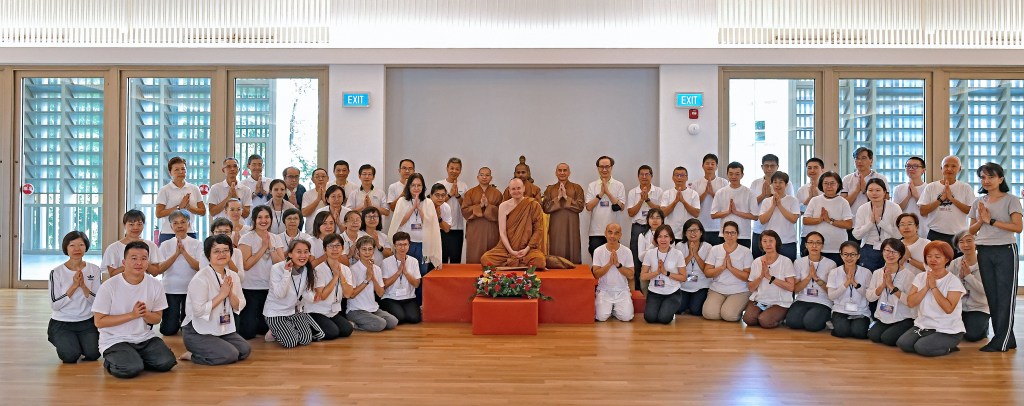
Ajahn Achalo who hit 3000 hours of meditation was here in Singapore. I was inspired by him and also started to count the hours of meditation, hoping to reach 3000 hours as well. Unless I live a long life, otherwise, I think I wouldn’t be able to hit 3000 hours. I attended his talk last Sunday at Palelai Temple. The sound system wasn’t good and I can hardly hear him speak. It’s good to meet the person whom inspire me. I hope I have a chance to listen to his teachings in Singapore again.

Peeping on Ajahn Achalo!

After completing another 130 hours of meditation, meditating isn’t such a hurry. Sitting without expectation, with nowhere to go and nothing to grasp on. It is the calm mind that makes one continue to strive. It doesn’t matter where I arrive in my meditation as long as the mind is peaceful and nature would do its job. Stabilising the calm mind is all I need – the longer the better. The mind has to be trained to be calm quickly and naturally whenever I sit. To be able to bring the mind to the present in whatever I do. Be able to abandon unwholesome thought quickly and always remain calm. That’s the training of the mind. That’s the purpose of meditation. With such a purpose I’m able to experience and understand the Buddha’s teachings. Teachings from the pali canon, the nikayas.

I remember I heard a lay teacher said that we should get up if we are dozing off when we meditate. Somehow I don’t agree. I carry on sitting. Although dozing off a little, my mind is aware of the drowsiness. But when the drowsiness ceases, my mind was sharp and clear even though that last only for less than a minute. I try to sustain that clarity of mind and am fully aware of the arising and ceasing of this clarity. I guess this is part of the training.

I hope there’ll be improvement when I reach 600 hours of meditation. Even if it means just a little…

I wasn’t confident when Companion Vet was recommended by our regular vet but Dr Miles may be different…

Companion Vet? It is going to be very expensive. Nothing comes cheap there. But BG had to go ahead with the surgery. Live or die!

There’s always risk in every surgery, human or animal. I still wasn’t sure. So far the cats I sent to Companion Vet, non came home alive. I kept reminding myself that it was Dr Miles who was doing the surgery. The western vet is constantly praised by the clients. We had to try!

BG before surgery. All I wish is give him what he was never given by his previous owner which is lots of food and love. So please BG be strong!

Little BG after surgery. His temperature went unusually low after surgery. I kept as calm as I could and rushed to the clinic. I kept calling his name on my way to the clinic. I wanted him to be strong, get up and keep himself warm.

The nurses said he ate a lot, really a lot and another vet suggested that we shouldn’t restrict his diet and should let him eat as much as he wants. That’s what all pet owners like to hear, to let our pets eat as much as they want!

The vet bill round up to around 5k and we’re glad that we’re able to raise enough funds to lessen our load. This was unexpected. I told Mel that we may only be able to raise between $400 to $600 and we were even prepared for less.

The next thing I’m going to focus on is to make sure that all would go back to normal for BG. Right now he is still constipated due to anesthesia.

He is sleeping soundly now. Dr Miles said he is a lazy old cat:). But we didn’t know how much he had suffered before we took him home. All I know is he needs a good rest.

What is Buddha nature?

Buddha nature not only consists of loving-kindness and compassion. The core of the Buddha nature is to understand the teachings taught by the Buddha Himself and to dwell in meditation like the Buddha did; to be able to penetrate the Four Noble Truths profoundly and to sit calmly meditating on what we’ve learnt from his teachings and eventually to gain insights. Without nirvana as our liberation and the Dhamma taught by the Buddha, Buddha nature is nowhere to be found.

We can find goodwill and loving-kindness in animals. I’ve seen an adult cat protecting a kitten and giving up his food for the kitten. When a cat was being attacked, another cat came for her rescue. My adopted cat, Cashie, comforted all the rescues I brought home. There are so many such cases out there. This is perhaps what we call a human nature.

To have a Buddha nature, we must have a mind of liberation. Buddha was called a Buddha because He had realised the Four Noble Truths himself and experienced the Jhanas and Nirvana. Thus, he is called a Buddha. And who are we to overwrite his teachings? Nobody possess his qualities. Only a person who have understood his teachings well would understand the heart of the Buddha and to understand the heart of the Buddha must start with his teachings, the suttas, and no one else. Not forgetting, Buddha refused to teach when he was enlightened. It was Brahma Sahampati who persuaded the Buddha to teach and this in fact is enough to tell me the entire truth (it was claimed by the mahayana tradition that out of compassion, Buddha taught the Dhamma but the actual fact was Buddha was not only reluctant but had no intention to teach). However, I was deluded and it took me years to be able to see and accept this. Therefore, I strongly believe many are still in delusion, not seeing or refusing to accept the truth.

We may not understand the Buddha’s teachings overnight but if we’re patient, insights would eventually arise in us and we’ve nothing to doubt because the teachings were from the Buddha. Understand the Buddha only through his teachings.

Conclusion:

Until we have a mind of the Buddha, we’re still in the state of human nature. Not only can we find loving-kindness and compassion all over the Pali Canon, we can also find the truth of what the Buddha taught. Stay firm, stay true and practise accordingly to the Buddha’s teachings and there is no way one would abandon the Dhamma and believe anything outside the Buddha’s teachings.