Feeds:
Posts
Comments

Archive for the ‘Teachings to remember’ Category

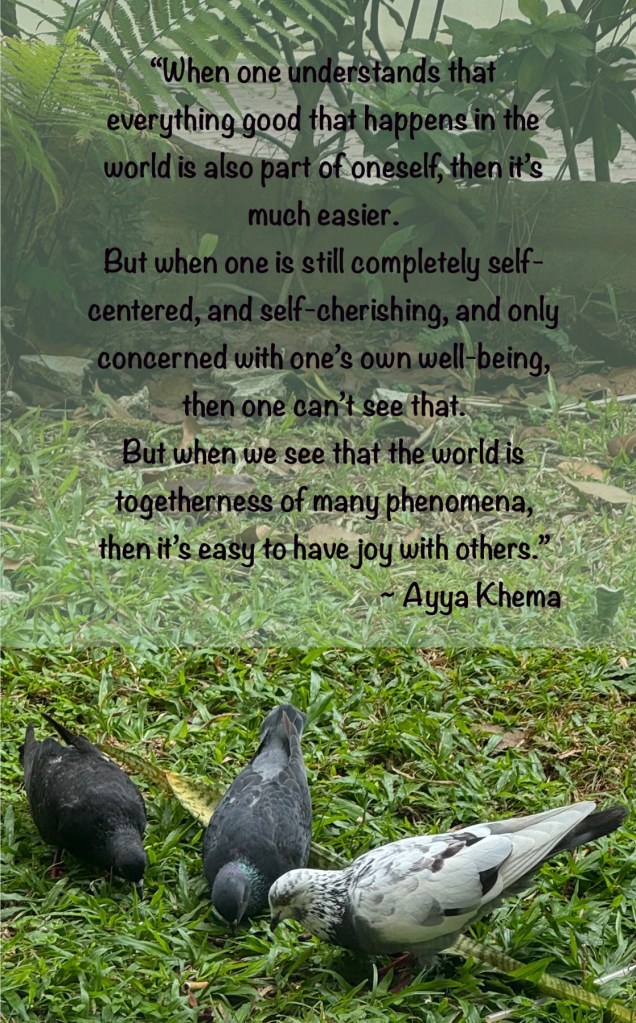
Quoted from the book “The Path to Peace”. Ayya Khema was trying to explain that we should rejoice in the good fortune of all living beings. Treating others with kindness is treating ourselves with kindness. We are all one.

Feeling joyful for the animals who have food to eat, colleagues who have promoted or those who have done good deeds is the purest form of joy. Consistently practise in this way brings us inner peace.

Be kind to all living beings. Smile when pigeons have food to eat:).

Please support using humane measures to control pigeon population. Below link is the petition to end pigeon culling.

https://chng.it/tWCDMhpPkf

Read Full Post »

Read Full Post »

The book talks about the life of the Buddha. What touches me was the way the Buddha practised using self-mortification. Buddha’s hard work will not be in vain for I’ll practise in accordance with his teaching and this is the only way to honour and be grateful to the Buddha.

S.Dhammika made the Buddha’s history come alive. He also listed the buildings or sites as what we see today that were once seen and walked by the Buddha. Below is the link to the book.

https://budblooms.org/2022/04/05/footprints-in-the-dust-the-life-of-the-buddha-from-the-most-ancient-sources/

Below are the quotes that I find it beneficial to me.

“Suppose a man wandering through the forest were to see an ancient road or path traversed by people in days gone by and he were to follow it until he came to an ancient city once inhabited by people, with parks and groves; reservoirs and walls—a really beautiful place. Then that man would inform the king or one of good ministers about it and say, ‘Sir, restore that city!’, and they would, and in time it would become rich and prosperous, crowded and full of people, so that it would grow and flourish again. In the same way I saw an ancient road or path traversed by fully awakened Buddhas in the past. And what is that ancient path, that ancient road? It is the Noble Eightfold Path”.

“Before my awakening I thought like this:’ Being myself subject to birth, ageing, sickness, death, sorrow and defilement, and having understood the dangers in them, I should seek after the unageing, unailing, deathless, sorrowless, and undefiled security from bondage, Nirvana.’ So later, while still young, with black hair, endowed with the blessings of youth and in the prime of life, despite my mother and father objecting with tear stained faces, I shaved off my hair and beard, put on the yellow robe and went forth from the home into homelessness “.

“Such was my asceticism that I went naked, rejecting conventions, licking my hands, ignoring requests to come for alms, refusing food specifically prepared for me or an invitation to a meal… I took food only once a day, or only once every two days, or only every three, four, five, six or seven days. I was an eater of teak leaves, millet, wild rice, hide parings, rice bran and the scum from boiled rice, of sesame pomace, grass and even cow dung. I foraged for forest roots, fruit or the fruit that had fallen from the tree… I was one who pulled out my hair and beard [rather than shaving], I remained standing or squatting for extended periods, I slept on a bed of thorns, I immersed myself in the river three times a day, sometimes at night. Just as grime and dust on a tree stump peels off and flakes off, like that the grime and dust that had adhered to my body over the years peeled off and flaked off, and yet it never occurred to me to wipe it off… I went on all fours to the core kraals after the cows and cowherds had gone and ate the dung of the suckling calves. As long as my own faeces and urine lasted. I consumed my own faeces and urine. I would plunge into the fearful forest, fearful enough to make one’s hair stand on end if one was not free from lust. During the cold winters I would spend the night out in the open, and during the summer I would spend the day similarly…”

“Because I ate so little, my backbone looked like a string of beads, my ribs like the rafters of an old shed, my eyes sunk into their sockets, and the gleam in my eyes looked like the gleam in the water at the bottom of a deep well. Because I ate so little, my scalp shrivelled and dried up like a gourd withered in the sun. If I tried to touch my backbone, it was the skin of my belly I touched. I would get up to urinate or defecate and fall down on my face, and if I stroked my limbs, the hair, rotted at its roots, fell out “.

“[W]ith my teeth clenched and my tongue pressed against my palate, I crushed, subdued, and suppress my mind using my mind”. 

“Such was my isolation that I would enter some forest and remain there. If I saw a cowherd or a shepherd, a grass-cutter, twig gatherers or a woodsman, I would flee from one grove or thicket to another, from one gully or upland to another, so that they would not see me or I them”.

“While I dwelt [in the forest], a wild animal would prowl somewhere near me, a peacock would snap a twig or the wind would rustle the leaves, and I would think, ‘Here comes that fear and dread. Why am I staying here getting nothing but fear and dread? I will master it and remain without moving.”

“I thought, ‘Why am I afraid of that happiness that has nothing to do with sensual pleasures and unskillful states of mind?’ And I thought, ‘I am not afraid of that happiness.’ Then I considered further. ‘It is not easy to attain that happiness with such a severely emaciated body. I should eat some solid food, some boiled rice and barley porridge.’ And so I did…

“Then, being a seeker for the good, searching for the incomparable, matchless path of peace, while walking on tour through Magadha, I arrived at Uruvelà, the army village. There I beheld a beautiful stretch of ground, a lovely woodland grove, a clear flowing river with a delightful ford and a village nearby for support. And I thought, ‘ This is a good place for a young man set on striving.’ So I sat down there “.

“I recalled that when my Sakyan father was working and I was sitting in the shade of a jambu tree with my mind completely secluded from sensual pleasures and unskilled states of mind, I entered and remained in the first jhāna which had a joy and happiness born of seclusion together with applied and sustained thought. And I thought, ‘Could this be the way to awakening?’ …And I decided that indeed, this is the way “.

“Tireless energy was aroused in me and continuous mindfulness, my body was calm and untroubled, my mind concentrated and unified. Then, quite secluded from sensual pleasures and unskilled states of mind, I entered and remained in the first jhāna, which had a joy and happiness born of seclusion, together with applied and sustained thought. Then, with the ceasing of the applied and sustained thought, I entered and remained in the second jhāna, with inner tranquility, oneness of mind, an absence of applied and sustained thought and has joy and happiness born of concentration. With the fading of that joy, equanimous, mindful and with the body at ease, I entered the third jhāna, experiencing the happiness of which the worthy ones say, ‘Happily lives he who is equanimous and mindful.’ Then, with the giving up of both happiness and sorrow, pleasure and pain, I entered and remained in the fourth jhāna, beyond pleasure and pain and with a mindfulness purified by equanimity “.

“The truth I have realised is profound, difficult to see and understand, peaceful and sublime, impenetrable by mere reasoning, subtle, and accessible only to those who are wise. But people nowadays delight and rejoice in the things of the world, and it would be hard for them to see this truth, that is, how things come into being according to conditions. It would be hard for them to see this truth, that is, the stilling of all mental constructs, the letting go of all attachments, the destruction of craving leading to dispassion, cessation, Nirvana. If I were to teach this truth to them, they would not understand me, and that would be wearisome and troublesome for me “.

“Lord, teach the Dhamma, let the Happy One teach the Dhamma. There are beings with little dust in their eyes who are wasting away through not hearing it. There will be those who will understand it”.

“In a pond of blue, pink or white lotuses some sprout and grow in the water but never reach the surface, others grow up but remain on the surface, and a few grow above the surface and stand there untouched by the water. In the same way, I saw beings with little dust in their eyes and much dust, quick witted and slow witted, with good disposition and bad ones, amenable to instruction and resistant to it, only a few of them seeing the danger in doing wrong and its results in the future”.

The Lord is awakened; he teaches the Dhamma for awakening. The Lord is tamed; he teaches the Dhamma for taming. The Lord is calmed; he teaches the Dhamma for calming.

“Whether Tathāgatas appear in the world or not, this order exists: the fixed nature of phenomena, their regular pattern and their general conditionality. The Tathāgata discovers this and comprehends it and, having done so, he points it out and teaches it, explains and establishes it, reveals, analyses and clarifies it and says ‘Look’.”

“There is one person who is born into the world for the welfare of the many, for the happiness of the many, out of compassion for the world, for the welfare and happiness of both gods and humans. Who is that person? It is the Tathāgata, the Worthy One, the fully awakened Buddha”.

“Suppose a man wanting to cross a river were to take an axe, go into a forest and chop down a young, straight tree, one without any knots. He would lop off the crown, strip the foliage and branches off, shape the log with the axe, trim it with an adze, smooth it with a scraper, then polish it with a stone ball and, having done so, set out across the river. What do you think? Would he be able to cross the river?”

The man answered:

“No sir, he would not. Because although the log has been well shaped on the outside, it had not been cleaned out on the inside”.

“Imagine a lovely, delightful river and a man being carried along it by the current. Then imagine that a perceptive man standing on the bank were to see this and call out, ‘Hey sir! Further downstream there are rapids and whirlpools, crocodiles and demons, and if you end up there you will suffer death or death-like pain.’ Hearing this, the man in the river would struggle against the current with his hands and feet “.

“Sir, some samanas and brahmins come to Kesaputta and proclaim and explain their own doctrine and then criticise, condemn, deride and clip the wings of the doctrines of others. Then other samanas and brahmins come and do the same to what the earlier ones had said. We are on doubt, we are confused as to which of these respected teachers is speaking the truth and which falsehood”.

“Who does the samana Gotama speak with? From whom does he get his lucidity of wisdom? His wisdom is destroyed by living in solitude, he is unused to discussions, he is no good at speaking, he is completely out of touch. The samanas Gotama is like an antelope that circles around and keeps to the edges “.

“I tell you this. Let an intelligent person who is sincere, honest and straightforward come to me, and I will teach him Dhamma. If he practises as he is taught, within seven days, and by his own knowledge and vision, he will attain that holy life and goal. Now you may think that I say this just to get disciples or to make you abandon your rules. But this is not so. Keep your teacher and continue to follow your rules. You may think that I say this so you will give up your way of life, follow things you consider bad or reject things you consider good. But this is not so. Live as you see fit and continue to reject things you consider bad and follow things you consider good. But there are states that are unhelpful and defiled, causing rebirth, fearful, distressful and associated with birth, decay and death, and it is only for the overcoming of these things that I teach the Dhamma”. 

“It is not easy to teach the Dhamma to others, so when you do so establish these five things in yourself first. Teach the Dhamma to others, thinking, ‘I will teach in a gradual way. I will teach keeping the goal in mind. I will teach out of kindness. I will not teach for personal gain, and I will teach neither to my own detriment or the detriment of others’.”

“When I am dwelling dependent on a village or town, I dress in the morning, take my robe and bowl and enter that village out town for alms. After eating, I go into a nearby grove, make some grass or leaves into a pile and then sit down, crossing my legs and keeping my back straight, arouse mindfulness in front of me “.

“Having five qualities, a nurse is capable of tending to the sick. What five? He can prepare medicine; he knows what is effective and what is not and administers the elective, not the ineffective; he nurses the sick out of love, not out of hope for gain; he is unaffected by excrement and urine, blood and spittle; and from time to time he can instruct, inspire, gladden and comfort the sick with talk on Dhamma “.

“If anyone should criticise me, the Dhamma or the Sangha, you should not because of that be angry, resentful or upset. For if you did, that would hinder you and you would not be able to know whether what they said was right or wrong. Would you?

“No, Lord.”

“Therefore, if others criticise me, the Dhamma or the Sangha, simply explain what is incorrect, saying, ‘That is incorrect. That is not right. That of not our way. We do not do that.’ Likewise, if others should praise me, the Dhamma and the Sangha, you should not because of that be pleased, elated or self-satisfied. For if you were, that would hinder you. Therefore, if others praise me, the Dhamma or the Sangha, then simply explain what is correct, saying: ‘That is correct. That is right. That of our way. That is what we do’.”

“I have heard it said that you, good Gotama, teach that charity should only be given to you, not to others, to your disciples, not to the disciples of other teachers. Are those who say this representing your opinion without distorting it? Do they speak according to your teaching? In truth, good Gotama, I am anxious not to misrepresent you “.

The Buddha replied:

“Those who say this are not of my opinion; they misrepresent me and say something false. One who discourages another from giving charity hinders in three ways: he hinders the giver from receiving merit, he hinders the receiver from receiving the charity, and he has already ruined himself through his stinginess “.

The monk or the nun, the layman or the laywoman who lives by the Dhamma and perfectly fulfills it: it is they who honour me with the highest reverence.

Dīgha Nikāya II, 138

“Cultivate the friendship of Sāriputta and Moggallāna; associate with them, for they are wise and helpful to their companions in the spiritual life.Sāriputta is like a mother, and Moggallāna is like a foster-mother. Sāriputta trains others to attain the first stage leading to awakening, while Moggallāna trains them to attain the highest goal. Sāriputta is able to announce, teach, describe, establish, reveal, expound and exhibit the Four Noble Truths”.

“I will not pass away until the monks and the nuns, the lay men and the lay women are learned and well-trained, skilled and competent, erudite in the Dhamma and walk the path of the Dhamma; not until they, with confidence in the teachings, can pass on to others whether have learned from the Teacher, explain it and established it, expound it, analyse it and make it clear; not until they can use it to thoroughly refute false teachings that have appeared and proclaim the Dhamma in all its wonder”.

“The person who accumulate wealth lawfully and without harming others and, in doing so, makes himself happy and fulfilled, shares it with others, does good works, makes use of it without greed or infatuation, aware of its limitations and keeping in mind his own spiritual growth, is praise on all these counts”.

“Monks, in the training of the worthy ones, singing is wailing, dancing is derangement, and laughing so much that it shows the teeth is infantile. Therefore, do away with singing and dancing, although it is acceptable to give a smile if the Dhamma makes you glad”.

“Just as great rivers such as the Ganges and Yamuna, Achivaratī, Sarabhū and the Mahī lose their names and identities when they reach the great ocean and become just ‘great ocean’, like that, on leaving their homes and entering the Dhamma and training taught by the Tathāgata, warriors, brahmins, merchants and menial lose their names and identities and become just ‘sons of the Sakyan’.”

“We will eat in moderation. Reflecting wisely, we will not eat for fun, for amusement or for physical attractiveness but only for the maintenance and continuance of this body, for allaying the pangs of hunger, for assisting in living the holy life and with the thought, ‘I will end the old desires and not encourage new ones and thus be healthy, blameless and live comfortably’.”

There is one thing which when it is present in the world is for the welfare and happiness, the good and the benefit of gods and humans. What is the one thing? It is unity in the Sangha.

Itivuttaka 11

“Is it true that you are arguing, quarreling, disputing and stabbing each other with the weapon of words; that you can neither convince nor persuade the others or be convinced or persuaded by them?”

They admitted that it was true, and the Buddha said:

“What do you think? When you are doing this, are you relating to your companions in the spiritual life with love through body, speech and mind, in public and in private?”

“No, Lord.”

“You foolish men! Can you not understand or see that this well be to your sorrow and suffering for a long time?”

“Lord, it is wonderful that you are comfortable and well again. When you were sick, my body felt as if it was drugged’ I was disorientated and things were not clear to me. But I was consoled by the thought that you will not pass away without making some statement regarding the monastic Sangha”.

Apparently surprised by this, the Buddha replied:

“But what does the Sangha expect from me, Ānanda? I have proclaimed the Dhamma without making any distinction between secret and open teachings. I do not have the teacher’s fist, which holds some teachings back. If anyone thinks, ‘I will take charge of the Sangha’ or ‘The Sangha should follow me’, then let them make such statement. But the Tathāgata does not think like that, so why should he make some such statement regarding the Sangha “?

Then he reiterated his appeal for self-reliance in spiritual matters:

“Ānanda, be an island unto yourself; be your own refuge, with the Dhamma as your island and refuge, with no other refuge. Whether now or after I have passed away, anyone who lives as their own island, their own refuge, will attain the highest, if they have the desire to learn “.

“These sal trees have burst into blossom out of season. Never before has the Tathāgata been so honoured and revered, respected, esteemed and saluted. But the monk or nun, the lay man or lay woman disciple who live practising the Dhamma fully and perfectly fulfils the path of the Dhamma, it is they who truly honour the Tathāgata, revere, respect and worship him in the highest way “.

Read Full Post »

The following quotes were taken from the small booklet titled No Ajahn Chah – Reflections, which I find helpful and meaningful to me.

60. Don’t think that only sitting with the eyes closed is practice. If you do think this way, then quickly change your thinking. Steady practice is keeping mindful in every posture, whether sitting, walking, standing or lying down. When coming out of sitting, don’t think that you are coming out of mediation, but that you are only changing postures. If you reflect in this way, you will have peace. Wherever you are, you will have this attitude of practice with you constantly. You will have a steady awareness within yourself.

62. I went all over looking for places to meditate. I didn’t realise it was already there, in my heart. All the meditation is right there inside you. Birth, old age, sickness, and death are right there within you. I travelled all over until I was ready to drop dead from exhaustion. Only then, when I stopped, did I find what I was looking for…inside me.

75. The basics in our practice should be first, to be honest and upright; second, to be wary of wrongdoing; and third, to be humble within one’s heart, to be aloof and content with little. If we are content with little in regards to speech and in all other things, we will see ourselves, we won’t be distracted. The mind will have a foundation of virtue, concentration, and wisdom.

77. Remember you don’t meditate to “get” anything, but to get “rid” of things. We do it, not with desire, but with letting go. If you “want” anything, you won’t find it.

142. There are two levels of practice. The first level forms the foundation, which is the development of virtue, the precepts, in order to bring happiness and harmony among people. The second level is the practice of Dhamma with the sole goal of liberating the heart. This liberation is the source of wisdom and compassion and is the true reason for the Buddha’s teaching. Understanding these two levels is the basis of true practice.

143. Virtue and morality are the mother and father of the Dhamma growing within us. They provide it with the proper nourishment and guidance.

145. Look after your virtue as a gardener takes care of his plants. Do not be attached to big or small, important or unimportant. Some people want shortcuts. They say, “Forget concentration, we’ll go straight to insight; forget virtue, we’ll start with concentration.” We have so many excuses for our attachments.

146. Right effort and virtue are not a question of what you do outwardly but of constant inner awareness and restraint. Thus, charity, if given with good intention, can bring happiness to oneself and to others. But virtue must be the root of this charity for it to be pure.

147. The Buddha taught us to refrain from what is bad, to do good, and to purify the heart. Our practice, then, is to get rid of what is worthless and keep what is valuable. Do you still have anything bad or unskillful in your heart? Of course! So why not clean house? But true practice is not only getting rid of what is bad and cultivating the good. This is only part of it. In the end we must go beyond both good and bad. Finally there is a freedom that includes all and a desirelessness from which love and wisdom naturally flow.

Read Full Post »

…quotes from the book…

The Deathless

The texts show the Buddha attaining the deathless at the moment of the realisation that made him a Buddha, rather than at the time of his passing away.

Like an old skin carried along and perhaps even cherished for a long time that now has lost all its former attraction, the desire for any realm or type of existence is to be abandoned in the deathless.

The complete realisation of the deathless stands for full liberation—that is, the complete removal of all defilements from the mind.

A use of the term “deathless” that is not confined to full awakening can also be seen in a set of Pali discourse without parallels, which name a range of lay practitioners who had come to know the deathless. Several of these are on record in other passages for having passed away at lower levels of realisation. It follows that the position of the texts in question is that the direct experience of the deathless is not the sole reserve of those who are arahants/arhats but is relevant also to stream-entry, once-return,  and nonreturn. As explained by Bodhi, the “terms used to describe these lay followers are descriptive of all noble ones from stream-entry on up. They all… are seers of nibbana, the deathless.”

Since the saint does not identify himself or herself with any of the khandhas(aggregates), the saint does not, in any way, participate in mortality… For at the so-called moment of death, what comes to an end is what does not belong to the saint… Strictly speaking the liberated saint does not die.

The early discourse distinguish five possible avenues for the breakthrough to awakening to take place. These are covered under the heading of “spheres of liberation”. Four of these relate to the teachings, namely by way of hearing them, communicating them to others, reciting them, and reflecting on them. The fifth is during actual meditation practice.

“Supported by seclusion, supported by dispassion, supported by cessation, leading to letting go.”

Presented in brief, a way of understanding this series is to take the first three to stand for seclusion from what is unwholesome, dispassion as fading away of craving, and an orientation toward the cessation of what is constructed (or what is dukkha/duhkha). Being supported by these three then leads to letting go in the sense of relinquishing, giving up, surrendering, and abandonment. Such letting go would have to comprise everything, without exception. For the plunge into the deathless to take place, the entire gamut of experience—based as it is on the central peg of construction in the form of an I-entity that is assumed to be at its centre and someone in control—would need to be relinquished, given up, surrendered, and abandoned.

The relevant Pali pericope relates the Dharma-eye to the understanding that all that is of a nature to arise is of a nature to cease.

Whatever there is, it is of a nature to arise; all of it having created, one attains the arising of the eye of Dharma that is free from any defilement.

Let go of what is before, let go of what is afterward, let go of what is in the middle, transcend becoming.

“What if I were neither to intend nor to construct?” So one neither intends nor constructs. For one who is not intending and not constructing, those very perception cease, other gross perceptions do not arise, and one experiences cessation.

In this way, the intending and constructing activity of the mind (that is, of the fourth aggregate in particular) comes to be subdued to such an extent that it becomes possible to step out of the process of perceiving, of connecting one perception with the next, as a result of which the experience of cessation becomes possible.

The discourse in question sets out on the contrast between a wild colt and a thoroughbred. A practitioner comparable to a wild colt is not free from the five hindrances (sensual desire, ill will, sloth-and-torpor, restlessness-and-worry, and doubt) and then meditates in dependence on various objects, such as the elements, the immaterial spheres, or what is experienced through the senses. In contrast, the way of practise for one comparable to a thoroughbred is based on the removal of the five hindrances. The actual practice then takes the following form in a Chinese version of the relevant passage:

One who meditates like this neither cultivates meditation in dependence on earth, nor cultivates meditation in dependence on water, fire, wind, space, consciousness, nothingness, neither-perception-not-nonprescription; neither cultivates meditation in dependence on this world, nor in dependence on that world, not [in dependence on] the sun and the moon, nor [in dependence on] what is seen, heard, experienced, and cognized, nor [in dependence on] what is attained, nor [in dependence on] what is accordingly realised, nor [in dependence on] what is accordingly contemplated.

“Such a form of meditation — if it can indeed be called such—goes beyond the whole range of objects a meditator could possibly take up and thereby beyond all known avenues of meditating. The parallels explain that any perception related to generally recognised objects of meditation “has disappeared,” with the practitioner has “subdued,” or else such perceptions are being seen as “false, not having a reality.”

This is peaceful, this is sublime, namely: the calming of all constructions, the letting go of all supports, the extinguishing of craving, dispassion, cessation,Nirvana.

(This is peaceful. This is sublime. That is the stilling of all activities. The relinquishing of all acquisition. The destruction of craving, dispassion, cessation, Nibbana).

“Nibbana is not an experience as dry as a lot of wood, but a state of serene awareness of its true significance. It is a transcendence of the world by realisation of its cessation.”

Monastics, there is that sphere where there is no earth, no water, no fire, no wind, no sphere of infinite space, no sphere of infinite consciousness, no sphere of nothingness, no sphere of neither-perception-nor-nonperception, not this world, not a world beyond, and not both the moon and the sun. Monastics, i say that there is also no coming, no going, no staying, no passing away, and no re-arising; indeed, it is unestablished, unmovable, and unsupported. This itself is the end of dukkha.

This “Nirvana” is surely a very strange entity which differs greatly from anything that we have ever met before, and has nothing in common with objects about which assertion is possible. In order to do justice to it, one must withdraw from everything by which, of which or with which anything can be asserted.

Indications found elsewhere among the early discourses concord with the impression that the breakthrough to the deathless was conceived as an arrival at what is true and real. A verse extant in Pali expresses the matter in the following way:

Nirvana is of a nondeceptive nature, That noble ones have truly known; Through the breakthrough to truth, They have become stilled and cool.

Due to the influence of defilements, all unawakened experiences will inevitably be tinged by what is deceptive and of a false nature.

The liberation of such a one is unshakable, being established in truth… this is indeed the supreme noble truth… namely Nirvana, which is of a nondeceptive nature.

Friend, one devoid of conduct does not know and see as it really is. One endowed with conduct knows and sees as it really is. Knowing and seeing as it really is, one becomes an end-maker [of dukkha/duhkha].

That is, although neither conduct nor knowledge causes awakening, conduct provides the foundation for knowledge and knowledge in turn the required preparation for awakening to take place.

The same point comes to the fore in another Pali discourse and its two Chinese parallels. The relevant discussion clarifies that none out of a set of seven types of purification, ranging from mortality to knowledge and vision, can be identified with final Nirvana. Nevertheless, each of these seven purifications leads on to the next, and the part in turn leads on to the realisation of final Nirvana .

Of a monastic knows as it really is the arising of the six [spheres of] contact, their cessation, their advantage, their disadvantage, and the escape from them, then this is supreme and leads out of all those views.

This is indeed baseless talk:” When the six spheres of contact have been eradicated, faded away, ceased, appeased, and disappeared, is there a remainder?” This is indeed baseless talk:” Is there no remainder?” This is indeed baseless talk:” Is there a remainder and no  remainder?” This is indeed baseless talk:” Is there neither a remainder nor no remainder?” If one says:” When the six spheres of contact have been eradicated, faded away, ceased, appeased, and disappeared, one is apart from all that is baseless and false and attains Nirvana,” then this is indeed what the Buddha taught.

Like a flame flung away by the force of wind, Goes out and is beyond reckoning, So the sage, freed from the category of name, Goes out and is beyond reckoning.

There is no measurement of one gone to the end; That by which one might speak [of the sage] no longer exist [for the sage]. All things being removed, All pathways of language are removed as well.

Anuruddha/Aniruddha was reflecting on key requirements for progress on the path, which led him to the realisation that the Buddha’s teaching is for one who has few desires, is content, resorts to seclusion, is energetic, mindful, concentrated, and wise. The Buddha reportedly added an eighth quality: delight in nonproliferation.

The perpetual eradication of lustful desires, the perpetual eradication of anger, the perpetual eradication of delusion, and the perpetual eradication of any defilements: this is called Nirvana.

Experiencing the final feeling tones in life, one then knows to be experiencing the final tones in life. One knows that, with the breaking up of the body and the ending of life, the life span having come to be completed, all that is being felt will be extinguished and cease, becoming cool…

It is like, for example, a lamp that burns in dependence on oil and in dependence on a wick. If nobody adds further oil and also does not supply the wick, what was there previously, having come to an end, will not continue further, with nothing more to be experienced.

When the dustless and stainless Dharma-eye arises in a noble disciple, with the arising of vision… three fetters of the noble disciple are eradicated: the view of a[reified sense] of identity, doubt, dogmatic clinging to conduct and observances [as in themselves liberating].

“Proliferation originates from perception” (Chinese) or else that “perception” is the root of proliferation “

Placed in a wider context of the average mode of progress on the path, then, practices such as sense restraint, bare awareness, and signless concentration, together with regular contemplation of impermanence, can provide the ”gradual” training of perception that then has its “sudden” complement in the transformative breakthrough to the unconstructed. These two dimensions of transforming perception—gradually and suddenly —in conjunction lead to complete freedom of the mind from defilements. In fact, even just cultivating sense restraint well can provide a basis for stepping out of the world created by the six spheres of contact:

With [sense} doors guarded and well restrained. Having abandoned the six spheres of contact, Having vomited out the root of misery, The eradication of the influxes has been attained by me.

Rightly seeing and knowing the arising of the world as it really is, there is no supposing that the world does not exist. Rightly seeing and knowing the ceasing of the world as it really is, there is no supposing that the world exists.

This is called being on the middle path taught apart from those two extremes; that is, because this is, that is; because of the arising of this, that arises; that is, conditioned by ignorance there are volitional construction…up to…the whole great mass of dukkha/duhkha arises. Because of the cessation of ignorance, volitional construction cease…up to…the whole great mass of dukkha/duhkha creates.

[A Tathāgata] has known that bodily form has been abandoned, has known that feeling time, perception, volitional constructions, and consciousness have been abandoned, abandoned at their root, like cutting off the head of a palm tree that will not grow any further branches and in the future will never arise again. It is thus not as if [a Tathāgata] were to reach the eastern direction, the southern, the western, or the northern direction; [instead, a Tathāgata] is extremely profound, vast, immeasurable, beyond reckoning, having forever ceased.

The self is the body, with its four elements and six sever spheres…which is indeed impermanent and will certainly fall apart, and this is correctly reckoned becoming completely annihilated.

Recluses and brahmins misrepresent my by falsely saying what is untrue:”The recluse Gotama proclaims what leads to annihilation; he proclaims the cutting off and destruction of truly existent sentient beings.” Yet, I make no statements about what herein does not exist. I do state that here and now the Tathāgata is free of sorrow.

“one who seeks happiness gains happiness,”

“happiness has been reached through happiness,”

“happiness has been gained through happiness,”

“very happy indeed is Nirvana,”

“the wise obtain happiness,”

“happily I shall delight in the happiness of liberation,”

“happily I lie down [or] stand; happily I live my life,”

“I meditate happily, [thinking:]’ oh happiness,”

“there is nothing superior to the happiness of Nirvana .”

The Buddha himself is no exception to this, being on record for indicating that he even sleeps happily. When getting no food, he is on record for proclaiming that he nevertheless lives on happiness, just feeding on meditative joy.

Having nothing, taking up nothing: This is the unsurpassable island. I call it “Nirvana,” The destruction of old age and death.

Monastics, there is that where there is no birth, where nothing has come into existence, where nothing is made, where nothing  constructed. Monastics, if there were not that where there is no birth, where nothing has come into existence, where nothing is made, where nothing is constructed, an escape from what is born, what has come into existence, what is made, and what is constructed would not be discernible here. But since there is that where there is no birth, monastics, where nothing has come into existence, where nothing is made, where nothing is constructed, therefore an escape from what is born, what has come into existence, what is made, and what is constructed is discernible .

The peaceful escape from that, Which is beyond the reach of reasoning and stable. Without birth and without an arising. Being a sorrowless and stainless track, The cessation of state of dukkha/duhkha, The stilling of constructions: [this is] happiness.

Whatever dukkha/duhkha manifests, It all depends on consciousness; With the cessation of consciousness, There is no [more] manifestation of dukkha/duhkha.

The body disintegrated, perception ceased, All feeling tones became cool, Constructions were stilled And consciousness came to an end.

Similarly, of those completely liberated, Who have transcended the flood of bandage to sensuality, Of those who have attained unshakable happiness, There is no designating their destiny.

Apart from letting go of everything, I see no safety for sentient beings.

Much can be said in praise of nibbāna to encourage the seeker, especially if it is in the form of simile or metaphor. Such we find frequently. But there must be nothing so concrete as to encourage attachment.

What is called the Nirvana element without residue? That is, monastics who have become arahants, have eradicated all the influxes, have established the holy life, have done what had to be done, have shed the heavy burden, have realised their own aim, have eradicated the fetter of becoming, have rightly understood, have been well liberated, and have gained penetrative knowledge. In the present, because there are no more impulsions and no more longings, which have all forever been extinguished, all that is being felt comes to be finally at peace, ultimately becomes cool, disappears, and no longer manifests.

Only purity is still there in the absence of what is of the substance of conceptual proliferation. Purity like this in the absence of what is of the substance of conceptual proliferation cannot be reckoned as “it exists,” cannot be reckoned as “it does not exist,” cannot be reckoned as “that exists as well as does not exist,” and cannot be reckoned as “that neither exists not does not exist.” It can only be called what cannot be designated, the ultimate, Nirvana. This is called the Nirvana element without a residue.

Such a form of deathlessness is still considered attainable while still alive, the first realisation of which already happens with steam-entry.

One of the approaches to inclining the mind toward the deathless, involves the perception that Nirvana is the cessation of “becoming” or “existence”. This conveniently encapsulates the basic principle that any holding on to some form of becoming or existence is diametrically opposed to the inclination towards Nirvana. In other words, any desire to become like this or like that, and any hope for an existence in this way or another way, stand a good chance of preventing the letting go required for the actual breakthrough to the deathless to the deathless to occur.

…the event of full awakening is considered to have very clear and directly evident repercussions: the fires of defilements of the mind have been quenched forever, and their ability to act as makers of signs during the process of perception has been nullified.

Nibbana is an island, yet that island is having nothing and taking up nothing. There is that where there is no birth, although to reify it as an unborn would be going too far. Light and darkness are both absent, all five aggregates cease, including consciousness, yet the destiny of those who have attained that much is beyond being disignated.

One way of trying to make practical sense of the instruction could be to assume that, based on being established in bare awareness, by letting go of one’s involvement with the content of experience and instead attending to its process character, ideally also to its constructed nature, one will not be thereby. Based on that, by letting go of the sense “I am” as some sort of epicenter that is in charge of experience, one will not be therein. By then letting go of any reference point whatsoever, one will be neither here, nor beyond, nor between the two. Such a successive deepening of letting go would be sufficient for actualizing the potential of liberating insight in regard to the six sense spheres, without any need to get involved with further details

Whose pasture is emptiness

And signless concentration

Their track is hard to trace,

Like that birds in the sky.

Read Full Post »
« Newer Posts - Older Posts »